Communicate Async at Work
Your calendar is a game of Tetris and every 'quick sync' could have been a paragraph. Async communication — written updates people read and answer on their own schedule — reclaims deep work hours without losing alignment. It is not about fewer meetings by decree; it is about making written updates the default and meetings the exception. Here is how to shift a team toward it.
TL;DR / Quick Fix
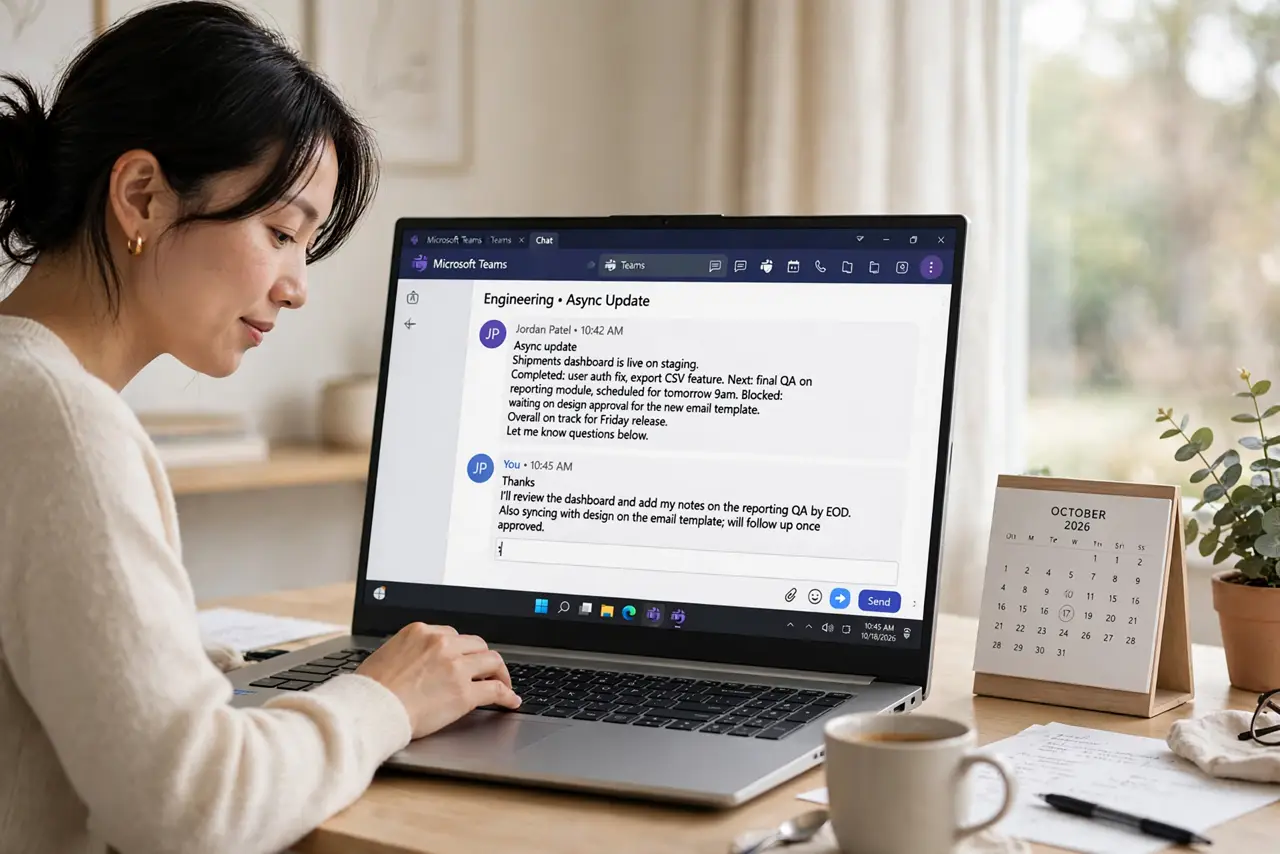
Quick fix: async communication replaces meetings with written updates people read on their time. Default to a shared doc or thread, state the decision needed and its deadline, and let people respond within a day. Reserve live meetings for disagreements and brainstorming — everything else can be a well-written message.
Follow these steps
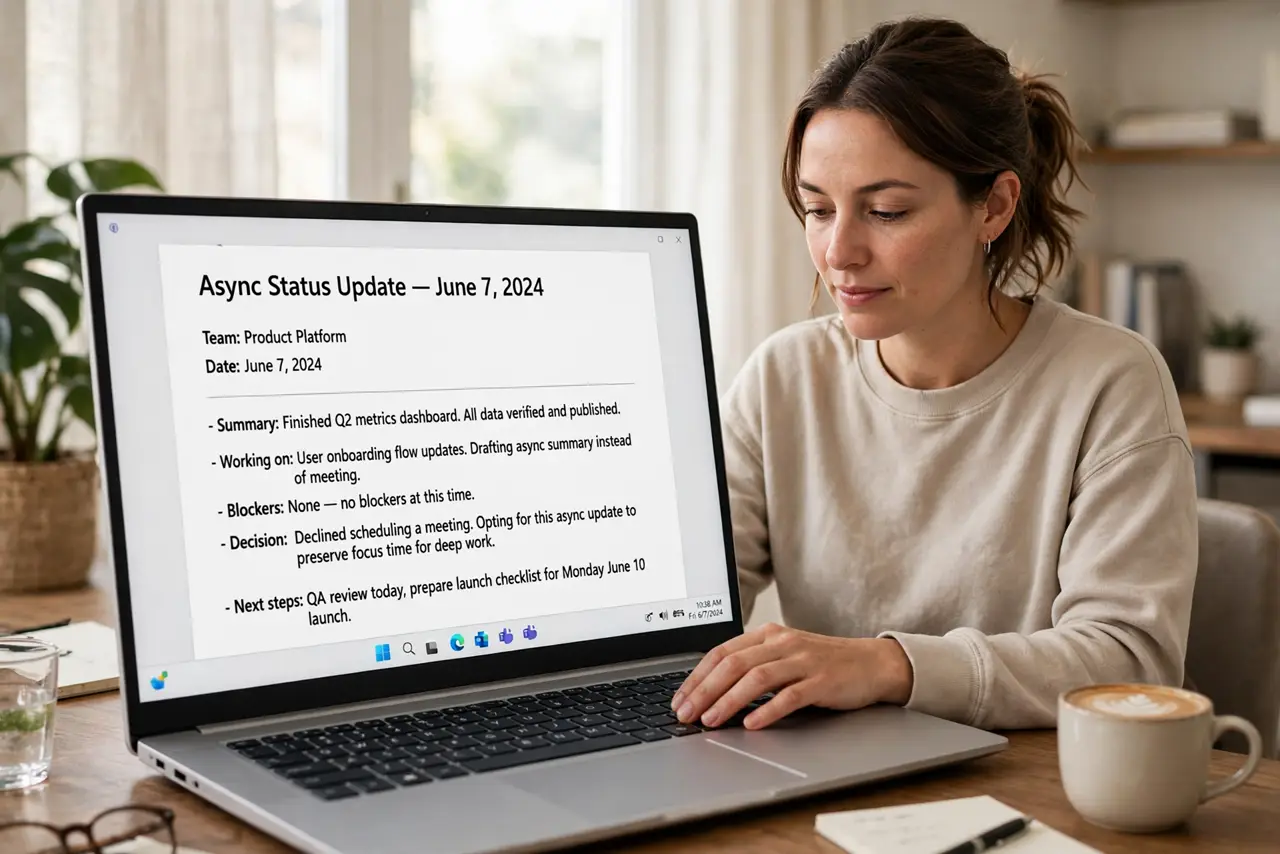
- Make writing the default, not the fallback. Before scheduling anything, ask: could this be a written update? Status reports, FYIs, simple approvals, and decisions with clear options all work better async. If yes, write it instead of booking it — the default is the culture.
- Write updates that decide things. A good async message has a context line, the options or proposal, what you need from whom, and a deadline. 'Thoughts?' with no deadline dies; 'Please approve option A or B by Thursday' gets answered. Pair it with a readable agenda format for bigger topics.
- Set response-time expectations explicitly. Async only works when people know the rhythm: same-day for normal messages, 24 hours for decisions, immediate only for true emergencies. Write the expectations down once, then everyone can stop anxiously watching the chat.
- Keep one home for each discussion. Decisions scattered across chat threads, email, and hallway talk get lost. One doc or thread per topic, linked from wherever people look. Future-you searching 'what did we decide' will be grateful.
- Reserve live meetings for what needs them. Disagreements, brainstorming, sensitive feedback, and complex tradeoffs deserve real conversation. Everything else — updates, approvals, simple questions — stays written. Fewer, better meetings beat a meeting-free fantasy.
- Protect the maker's schedule. Block focus time on your calendar so async hours stay yours. Async communication fails if everyone's calendar still invites over the writing time.
What NOT to do
- Do not go async by just canceling meetings. Removing meetings without writing good updates creates confusion, not freedom — the writing is the replacement.
- Do not write novels. Async updates should be scannable: headings, bullets, bold the ask. A wall of text gets the same neglect as a bad meeting.
- Do not expect instant replies. Demanding immediate answers to 'async' messages is just meetings with extra steps — honor the response window you set.
- Do not let decisions hide in chat scroll. A decision made in a thread nobody can find later might as well not exist — record it in the doc.
Frequently asked questions
Won't async slow decisions down?
Simple decisions get faster — no calendar Tetris. Complex or contested ones may take a day instead of an hour, but the written record prevents the re-debates that actually waste weeks.
How do I convince my team to try it?
Start with your own updates: write excellent async messages and watch meetings shrink. Propose a one-month trial for status meetings specifically — the easiest win.
What tools work best for async?
Whatever the team already opens daily — a shared doc, a dedicated chat channel, a project board. The tool matters less than the habit of writing decisions down.