Actual vs Planned in a Budget Spreadsheet
A budget nobody compares against reality is just a wish list. Putting planned and actual spending side by side shows exactly where the money went off-script, while the month is still young enough to fix it.
TL;DR / Quick Fix
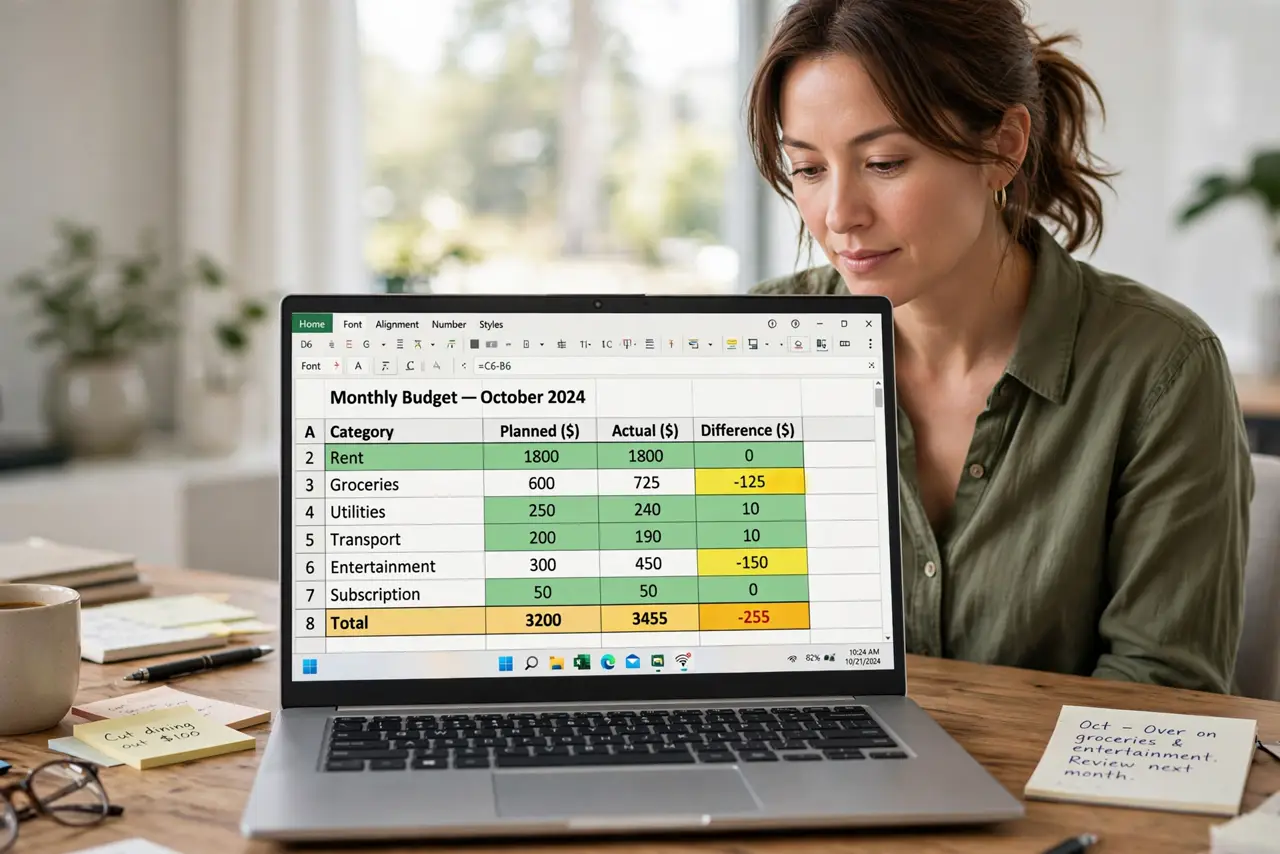
Quick fix: list each budget category with a planned column and an actual column, then add a difference column that subtracts one from the other. Review the biggest gaps monthly and move money between categories instead of pretending the plan was perfect.
Follow these steps
- List your spending categories. Write one row per category: housing, food, transport, and the rest. If a category is missing, spending in it hides from the comparison entirely.
- Add a planned column. Fill in what you intend to spend per category this month. Keep the numbers realistic, since a fantasy plan teaches you nothing when reality differs.
- Add an actual column. Enter what you really spent as the month goes, from bank statements or receipts. Estimates defeat the purpose, so use real numbers.
- Compute the difference automatically. In a third column, subtract planned from actual with a formula. Positive means over budget, negative means under, and the math stays honest.
- Review the biggest gaps monthly. Sort or scan for the largest differences. Two or three categories usually explain most of the gap, and those are the ones to fix.
- Move money between categories deliberately. When food runs over and transport runs under, shift the planned amounts. Adjusting the plan is budgeting; ignoring the gap is hoping.

What NOT to do
- Do not build the perfect budget and never compare it. An uncompared budget is decoration, while a monthly comparison is the actual tool.
- Do not use estimated actuals. Guessed spending hides the real leaks, so pull the numbers from statements and receipts.
- Do not punish yourself for one over-budget category. Move money, adjust the plan, and keep going, since guilt quits budgets faster than overspending does.
- Do not add twenty tiny categories at the start. Begin with the big ones that move the needle, and split them only when the detail earns its keep.
Frequently asked questions
How often should I compare planned and actual?
Monthly is the sweet spot. Weekly is tedious, and yearly is too late to fix anything.
What if I blow the budget every month?
The plan is probably unrealistic, not you. Raise the planned amounts to honest levels, then work on trimming one category at a time.
Should irregular expenses go in the monthly budget?
Yes, as a monthly average. A yearly bill divided by twelve keeps it visible instead of ambushing you once a year.