Credit Freeze vs Lock?
After a scare, advice splits: 'freeze your credit!' vs 'just lock it in the app!' They sound identical but differ in what backs them — federal law versus a bureau's product terms. Both restrict access to your credit file; the freeze carries legal weight, the lock carries convenience. Here's how to choose.

TL;DR / Quick Fix
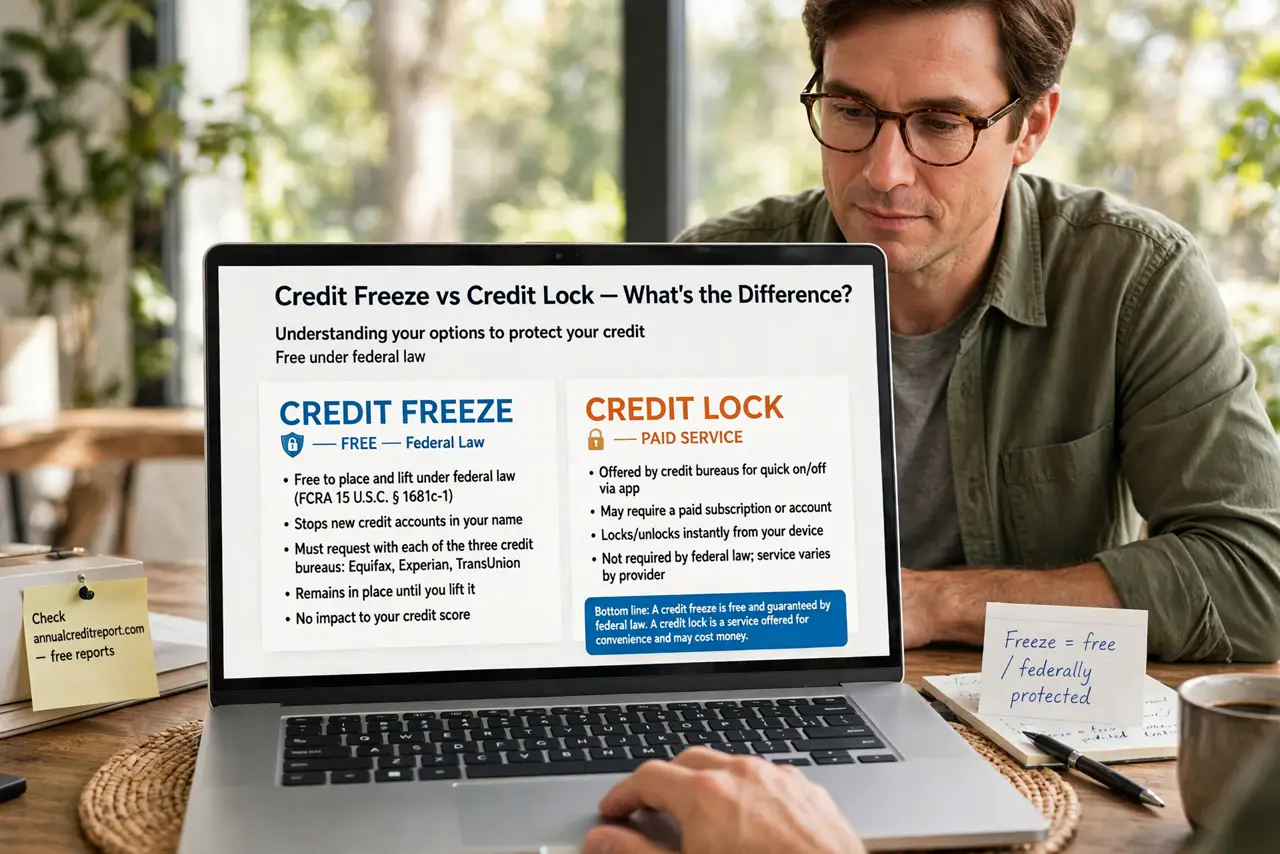
A credit freeze is free, federally regulated, and blocks new accounts in your name — a lock is a bureau product with similar effect but governed by the bureau's terms. Freezes are stronger legally; locks are often faster to toggle in apps. For maximum protection, freeze at all three bureaus.
Follow these steps
- Understand the freeze. A freeze is your right under federal law: free to place, lift, and remove, and bureaus must comply within set timeframes — see how to freeze.
- Understand the lock. A lock is the bureau's own product — similar blocking, but the terms are theirs, and some locks sit behind paid tiers or app requirements.
- Compare the legal backing. Freezes carry statutory protections and penalties for violations; locks carry contract terms. In a dispute, the freeze is the stronger instrument.
- Compare the convenience. Locks often toggle instantly in an app; freezes can take effect within an hour and lift on your schedule. For most people the difference is minutes.
- Freeze at all three bureaus. Equifax, Experian, TransUnion — a freeze at one doesn't cover the others. Locks likewise need enabling per bureau.
- Choose freeze as the default. Free, legally backed, and equally effective at blocking new accounts — the freeze wins for protection that matters. Use locks only for extra convenience.
What NOT to do
- Do not pay for a freeze. Freezes are free by federal law — any site charging for one is selling you something else.
- Do not freeze one bureau and stop. Lenders pull different bureaus; partial coverage leaves doors open.
- Do not confuse either with a fraud alert. Alerts warn lenders to verify — see fraud alerts — while freezes and locks block access outright.
- Do not forget to lift before applying. A freeze blocks legitimate applications too — schedule a temporary lift when you apply for credit.
Frequently asked questions
Does a freeze hurt my credit score?
No. Freezes don't affect your score at all — they only restrict who can pull your file for new accounts.
Can I still use my credit cards with a freeze?
Yes. Freezes block new accounts, not existing ones — your cards keep working normally.
Lock or freeze for a teenager's file?
Freeze — it's free, legally solid, and minors' files are prime synthetic-identity targets. Create and freeze the file before anyone else does.