Crimp Your Own Ethernet
You need a 7-foot cable and the store sells 3-foot or 25-foot — nothing in between. Crimping your own ethernet cables means custom lengths, clean runs, and no more coiled excess behind the desk. The skill takes one practice cable to learn.
TL;DR / Quick Fix
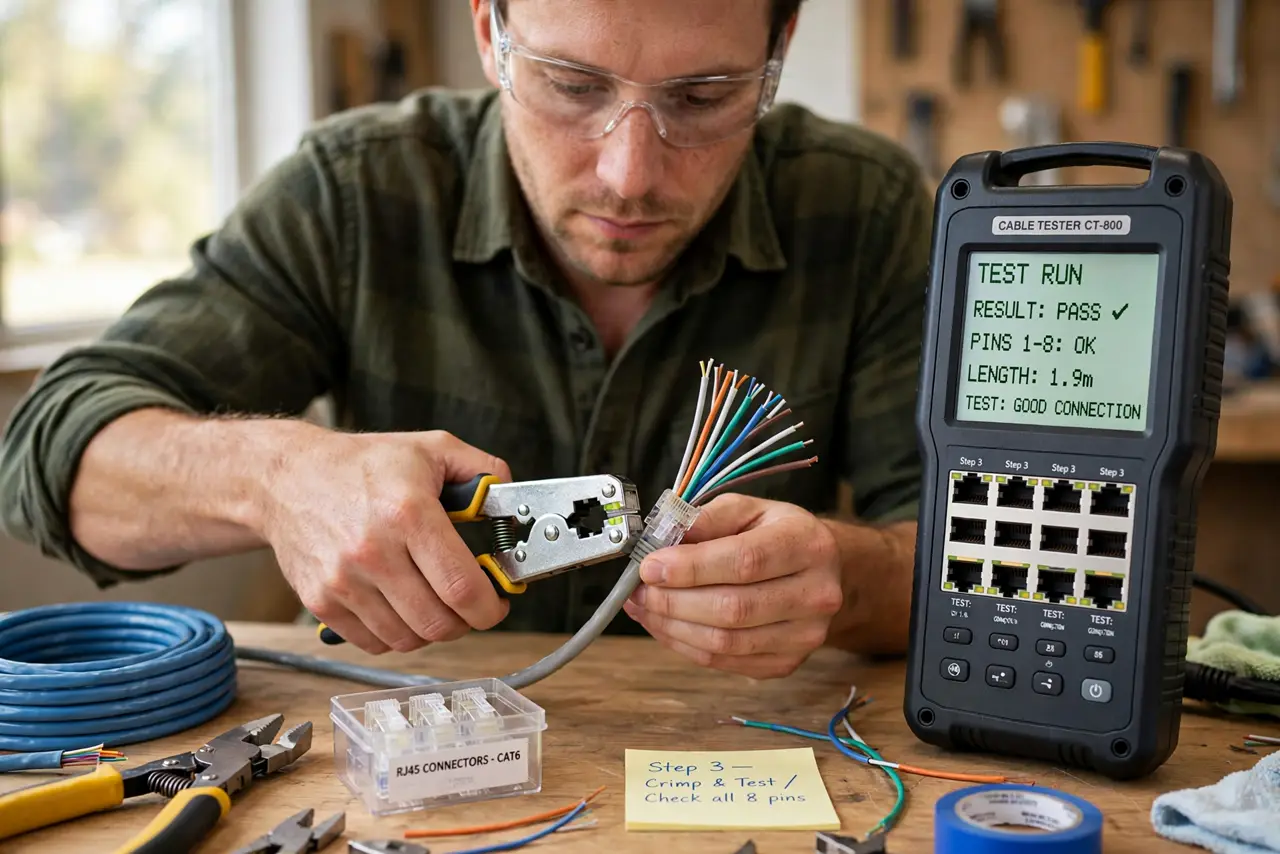
Quick fix: strip the cable jacket, arrange the eight wires in T568B order, trim them even, push into an RJ45 plug, and squeeze with a crimping tool. Test every cable with a cheap tester. Your first cable is practice — expect to redo it.
Follow these steps
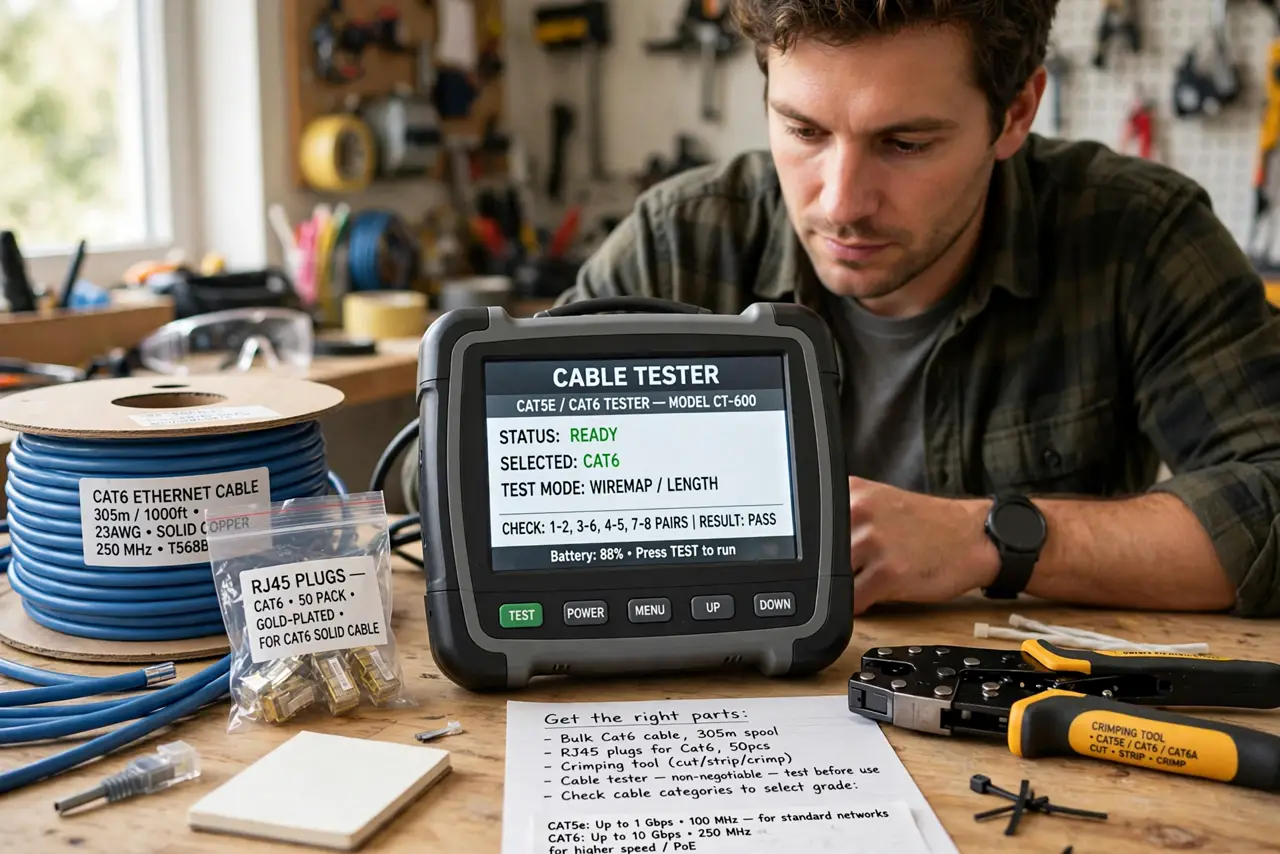
- Get the right parts. Bulk Cat5e or Cat6 cable, RJ45 plugs matching the cable type, a crimping tool, and a cable tester. The tester is non-negotiable — see the cable categories to pick the grade.
- Strip the jacket carefully. Remove about an inch of outer jacket without nicking the inner wires. Nicked wires break later — cut and restart if you score one.
- Arrange wires in T568B order. Orange-white, orange, green-white, blue, blue-white, green, brown-white, brown. Both ends identical for a standard cable.
- Trim straight and insert. Trim the wires to an even half-inch, then push firmly into the plug until each wire reaches the front. Look through the clear plug to verify.
- Crimp firmly. Squeeze the crimping tool hard — the pins must pierce each wire. A weak crimp is the top cause of flaky homemade cables.
- Test before installing. Plug both ends into the tester and confirm all eight lights sequence correctly. Never run an untested cable through a wall.
What NOT to do
- Do not skip the tester. Untested cables fail at the worst moment — inside a wall, after the drywall is up.
- Do not mix up the wire order. One swapped pair means a dead or degraded cable — the tester catches it.
- Do not crimp stranded vs. solid plugs wrong. Plugs are rated for one wire type; mismatching causes intermittent failures.
- Do not exceed length limits. Past about 100 meters, ethernet degrades regardless of crimp quality.
Frequently asked questions
Is homemade cable as good as store-bought?
Yes, if crimped and tested properly. Pros do exactly this for custom installs.
T568A or T568B?
Either works as long as both ends match. T568B is the common choice in homes — just be consistent.
Can I reuse an RJ45 plug?
No — crimping is one-shot. Cut it off and use a fresh plug; they cost pennies.