What Is Dolby Atmos?
Everything claims Dolby Atmos now — soundbars, phones, earbuds, TVs — and it cannot possibly mean the same thing on all of them. At its core, Atmos is object-based surround sound: instead of assigning sounds to fixed channels (left, right, center), mixers place sounds as objects in 3D space, including above you. A helicopter does not come from the left speaker; it moves overhead. What you actually hear depends entirely on the hardware playing it.
TL;DR / Quick Fix
Quick fix: Dolby Atmos is surround sound with height — sounds are placed as objects in 3D space, including above you, instead of fixed channels. You need Atmos content, a compatible soundbar or speakers, and ideally an eARC connection. Without height speakers or up-firing drivers, the effect is subtle.
Follow these steps
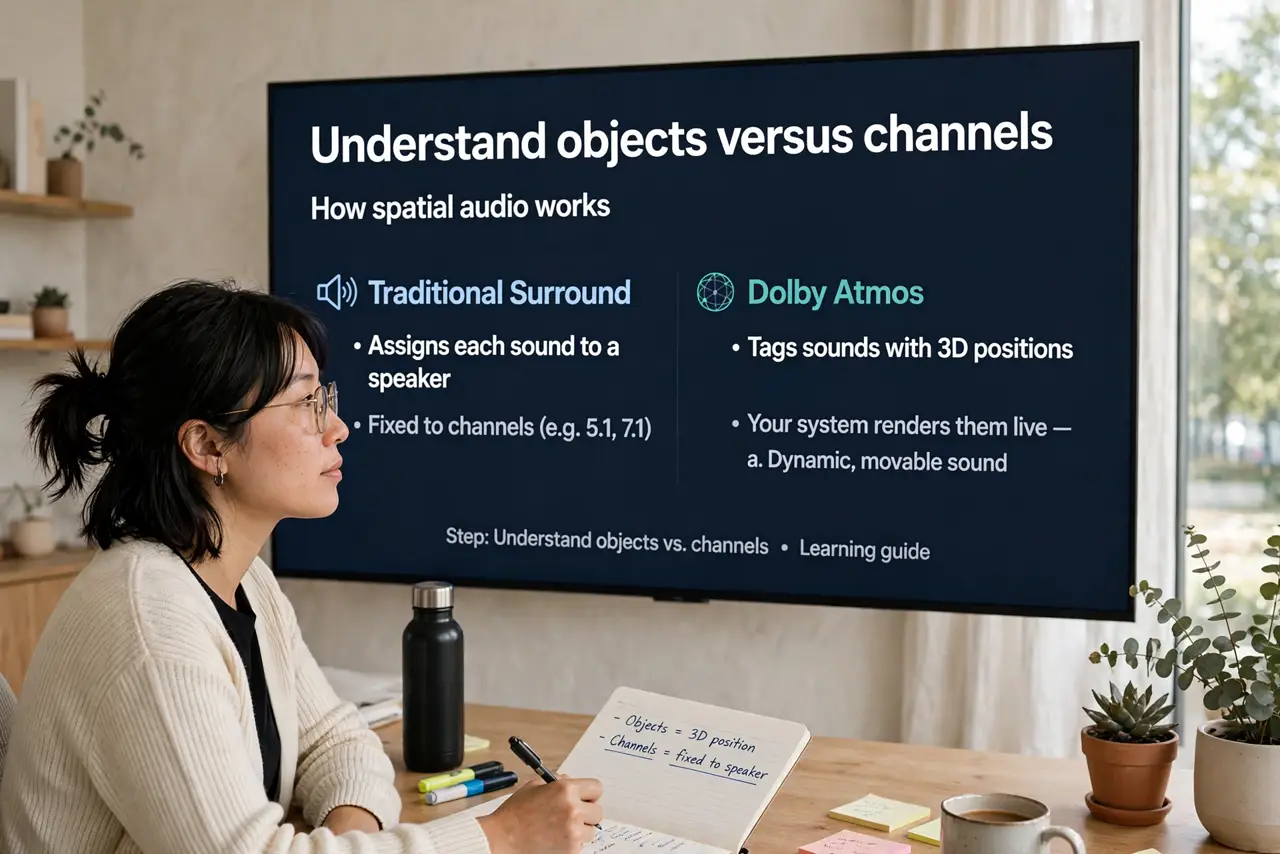
- Understand objects versus channels. Traditional surround assigns each sound to a speaker. Atmos tags sounds with 3D positions and your system renders them live — a rainstorm genuinely surrounds and covers you, because height is part of the mix, not an effect added later.
- Know the hardware ladder. Best: ceiling or up-firing height speakers. Good: a soundbar with up-firing drivers bouncing sound off the ceiling. Modest: virtualized Atmos in headphones or a basic bar. Same logo, very different experiences — the logo alone tells you almost nothing.
- Feed it real Atmos content. The badge on the box means nothing without Atmos-encoded movies, shows, or music. Check the title's audio details on your streaming service — no Atmos track, no Atmos sound, whatever the hardware claims.
- Connect it properly. From a TV, Atmos needs the bandwidth of eARC — plain ARC or optical silently downgrades it. Sources plugged directly into the soundbar also work; the chain is only as strong as its weakest link.
- Set realistic expectations by device. On a phone or earbuds, Atmos is tasteful virtualization — pleasant, not transformative. In a living room with height drivers, it is genuinely dramatic. Match your excitement to your hardware.
- Decide if it matters for your purchase. If you are choosing between a soundbar and separate speakers, know that real height effects need real height drivers — budget accordingly rather than paying for a badge on a bar that cannot render it.
What NOT to do
- Do not assume the Atmos logo guarantees the experience. A phone and a home theater share the name and almost nothing else — hardware decides.
- Do not expect height effects from a bar with no up-firing drivers. Without something aimed at the ceiling, overhead sound is marketing, not physics.
- Do not feed it through optical and wonder why it sounds flat. Optical cannot carry Atmos; the format dies at the cable.
- Do not pay extra for Atmos music if you only watch dialogue shows. The benefit scales with content that actually uses height — dramas gain little, action and nature gain a lot.
Frequently asked questions
Is Dolby Atmos better than regular surround sound?
With proper height hardware and real Atmos content, yes — the overhead dimension is genuinely new. Without height drivers, the difference over good 5.1 is modest.
Do I need special ceiling speakers?
They are the gold standard, but up-firing drivers that bounce sound off the ceiling get surprisingly close in rooms with flat, low ceilings.
Does Atmos work with my existing receiver?
Only if the receiver decodes Atmos — check its specs. Older receivers pass it through as plain surround at best.