Throttling vs Prioritization?
Your carrier slowed you down and the forums argue about whether it is 'throttling' or 'deprioritization' — as if the label changes your buffering video. The two are genuinely different mechanisms with different fixes, and knowing which one is hitting you saves you from buying the wrong solution. Here is the clear distinction, no jargon fog.

TL;DR / Quick Fix
Quick fix: throttling is a hard speed cap applied always (often after a data allowance); deprioritization is a temporary slowdown only during congestion after heavy use. Check your plan's fine print for which applies. Throttling needs a plan change; deprioritization often just needs patience or off-peak use.
Follow these steps
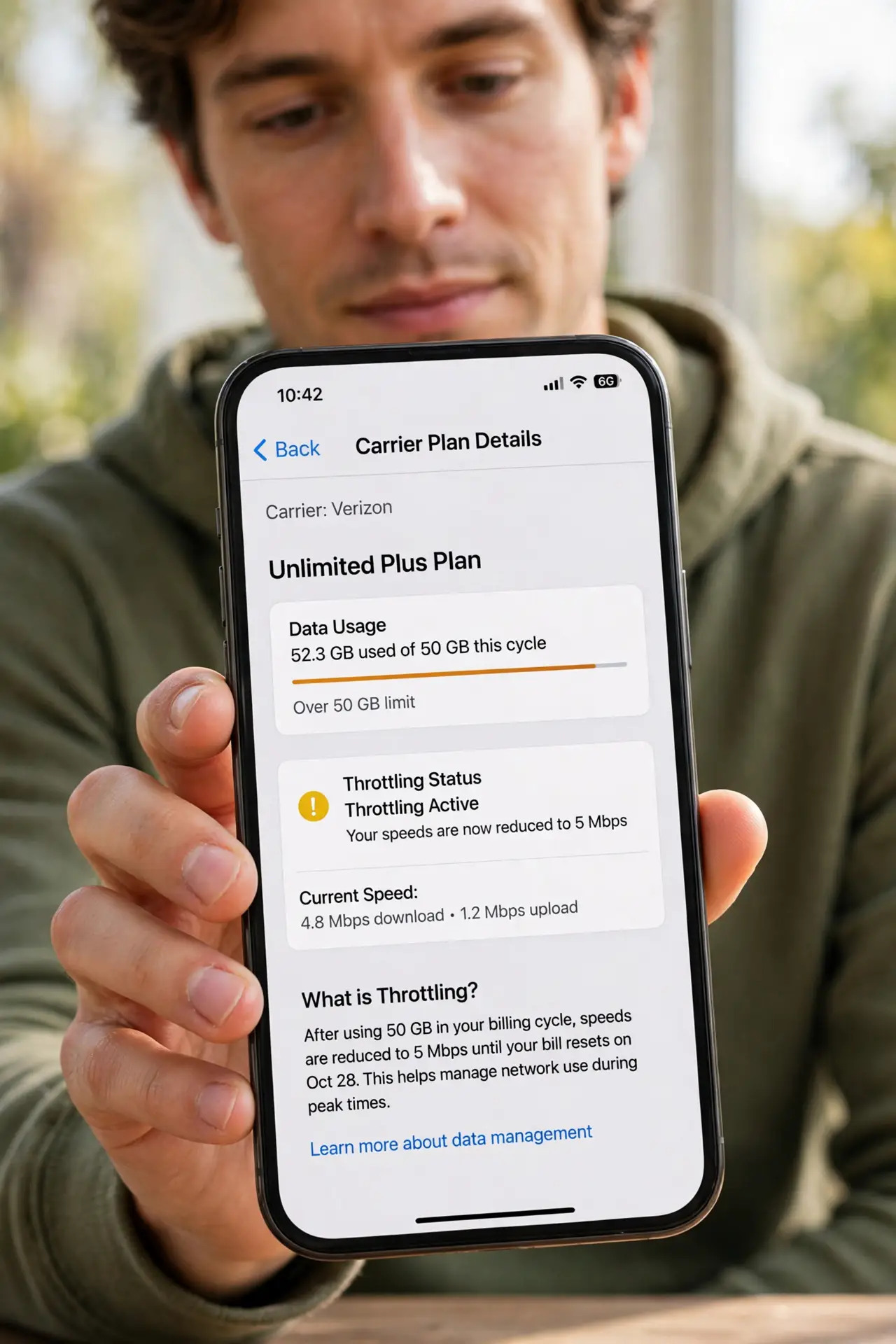
- Learn the throttling pattern. Throttling caps your speed to a fixed number — say 600 Kbps — once you exceed an allowance, and it stays capped until the cycle resets. It is predictable, constant, and indifferent to network load.
- Learn the deprioritization pattern. Deprioritization only slows you during congestion, and only after you pass a usage threshold. Off-peak you are full speed; at 8 PM in a crowded area you crawl. It is conditional — the key difference. Our data prioritization guide covers it in depth.
- Read your plan's fine print. Carriers must disclose both, usually in hilariously small text. Look for 'speeds reduced to X after Y GB' (throttling) versus 'data may be temporarily slower during congestion after Y GB' (deprioritization). The Y number matters enormously.
- Diagnose which one you have. Slow all the time after passing an allowance? Throttling. Fast at midnight, slow at dinner time? Deprioritization. The time-of-day test is the fastest diagnostic you have.
- Fix throttling with a plan change. Throttling only ends with a new billing cycle or a better plan — no trick defeats a hard cap. Compare plans by their throttle threshold and throttled speed, not the headline 'unlimited.'
- Manage deprioritization with timing. Shift big downloads to Wi-Fi and off-peak hours, and keep an eye on your usage versus the threshold. If you are chronically over it, a higher-threshold plan beats daily frustration.
What NOT to do
- Do not buy a VPN to beat throttling. Throttling is applied to your account's total usage — a VPN hides content, not how much you have used.
- Do not confuse either with a weak signal. Signal problems are location-dependent; throttling and deprioritization follow your account and usage.
- Do not assume 'unlimited' means unthrottled. Almost every unlimited plan has one or both mechanisms past some threshold — the word is marketing.
- Do not switch carriers blindly. Every carrier does one or both — compare thresholds and policies, not just prices and coverage maps.
Frequently asked questions
Which is worse: throttling or deprioritization?
Throttling — it is a constant cap you cannot escape until reset. Deprioritization at least gives you full speed off-peak.
Can the carrier throttle specific apps?
They are generally required to treat traffic neutrally, but 'network management' exceptions exist. App-specific slowdowns are more often the app or peering than carrier throttling.
Does this apply to home internet too?
Cable and fiber rarely throttle; 5G home internet commonly deprioritizes. Satellite varies by plan. Always check the fine print for your specific service.