Park Distractions Fast
You are finally focused, and then — did I reply to that email? I should buy milk. What was that idea for the presentation? Each stray thought yanks attention away, and 'just thinking about it for a second' costs far more than a second. The fix is not willpower; it is a parking lot: capture the thought in seconds, trust the capture, and return to work. This is the companion habit to single-tasking and a quiet notification diet.

TL;DR / Quick Fix
Quick fix: when a random thought pops up mid-task, write it on a 'parking lot' note in under five seconds and return to your work — the thought stops nagging because your brain trusts it is captured. Review the list later. This beats both fighting the thought and chasing it.
Follow these steps
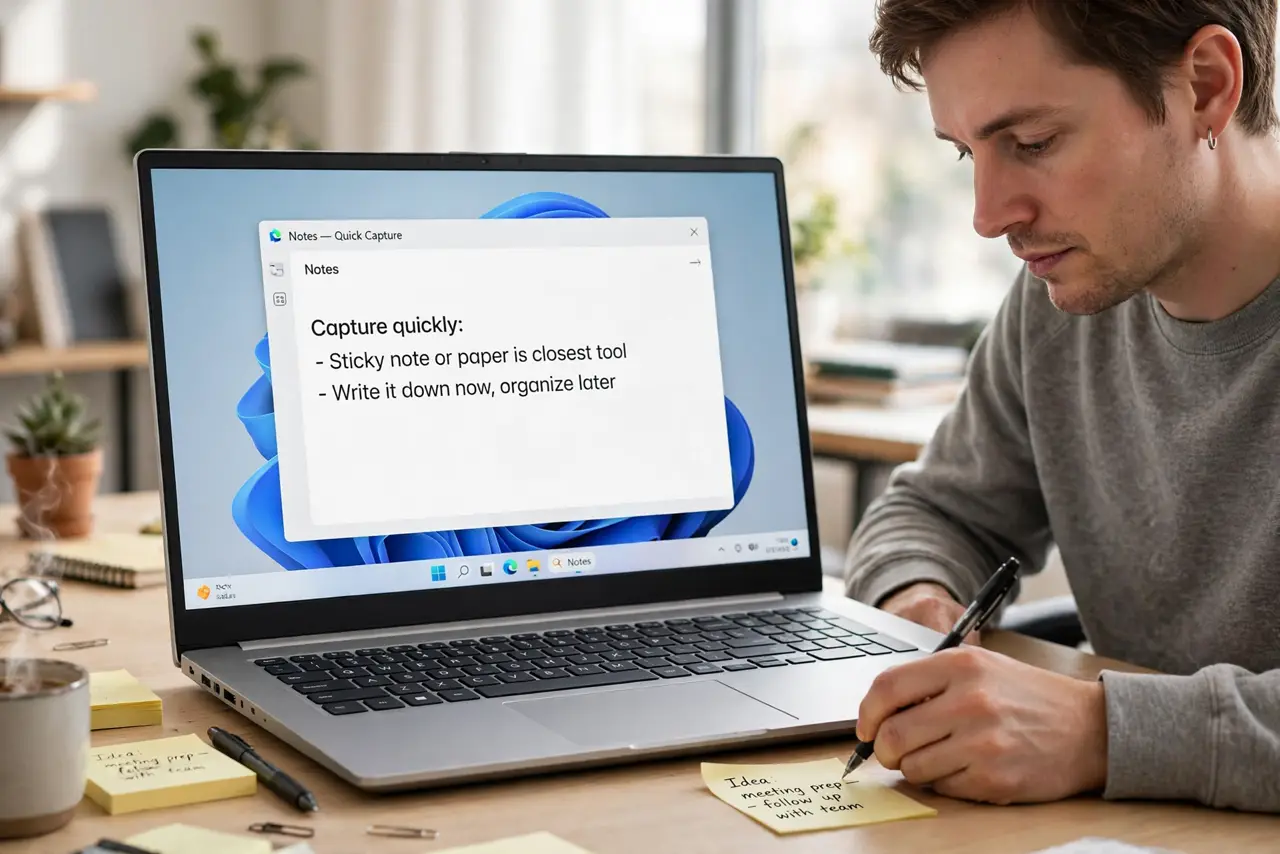
- Keep a capture tool within reach. A sticky note, a notes app, a scrap of paper — whatever is fastest for you. The tool must be one grab away; if capturing takes longer than the thought, you will skip it.
- Write the thought in under five seconds. A few words are enough: 'milk', 'reply Ana', 'roof quote'. You are parking it, not processing it — speed is the whole point.
- Return to the task immediately. Eyes back on the work the instant the pen lifts. Do not re-read the note, do not expand it — the note holds it, your attention returns to the job.
- Trust the capture completely. The nagging stops only if your brain believes the thought is safe. Glance at the growing list once to prove the system works — every parked item is still there, nothing lost.
- Review the lot once, at day's end. One review session: delete the trivia, schedule the real ones, act on the two-minute items. The parking lot empties daily — it is a buffer, not a second to-do list.
- Notice the pattern weekly. The same thought parked three days running is not a distraction — it is an unscheduled task or a worry asking for a plan. Promote repeats into your actual planning.
What NOT to do
- Do not fight the thought with willpower. Suppression makes it louder — capture is faster and actually works.
- Do not open the related app 'just to note it down.' Opening email to note an email thought is a trap — paper or a single notes app, nothing else.
- Do not let the parking lot become a to-do list. Unreviewed, it rots into guilt — the daily review is what makes parking trustworthy.
- Do not park and then keep thinking about it. The deal is capture-then-release — if you keep chewing on it, you did not really park it.
Frequently asked questions
What if the thought is actually urgent?
Then it is not a distraction — handle it. Parking is for the non-urgent; genuine emergencies get acted on immediately, then you return.
Paper or app — which is better?
Whichever you will actually use. Paper is faster and distraction-free; an app syncs everywhere. The best tool is the one within arm's reach.
Does this work for worries, not just tasks?
'Call the dentist about the bill' parks fine. Vague dread does not — convert worries into a concrete next action first, then park that.