Pick Bookshelf Speakers
Buying your first real speakers is exciting and slightly terrifying — the spec sheets shout wattage and frequency ranges that mean little, and every forum swears by a different brand. The truth is simpler: for a first pair, room size and honest reviews matter far more than specs, and good placement will do more than any upgrade. Here is how to pick a pair you will love for years, not months.
TL;DR / Quick Fix
Quick fix: pick bookshelf speakers by room size and use, not wattage hype — a well-reviewed pair with 4-5 inch woofers suits most desks and small rooms. Listen for clear voices, not just bass. Buy from a place with easy returns, position them well, and only then consider a subwoofer.
Follow these steps
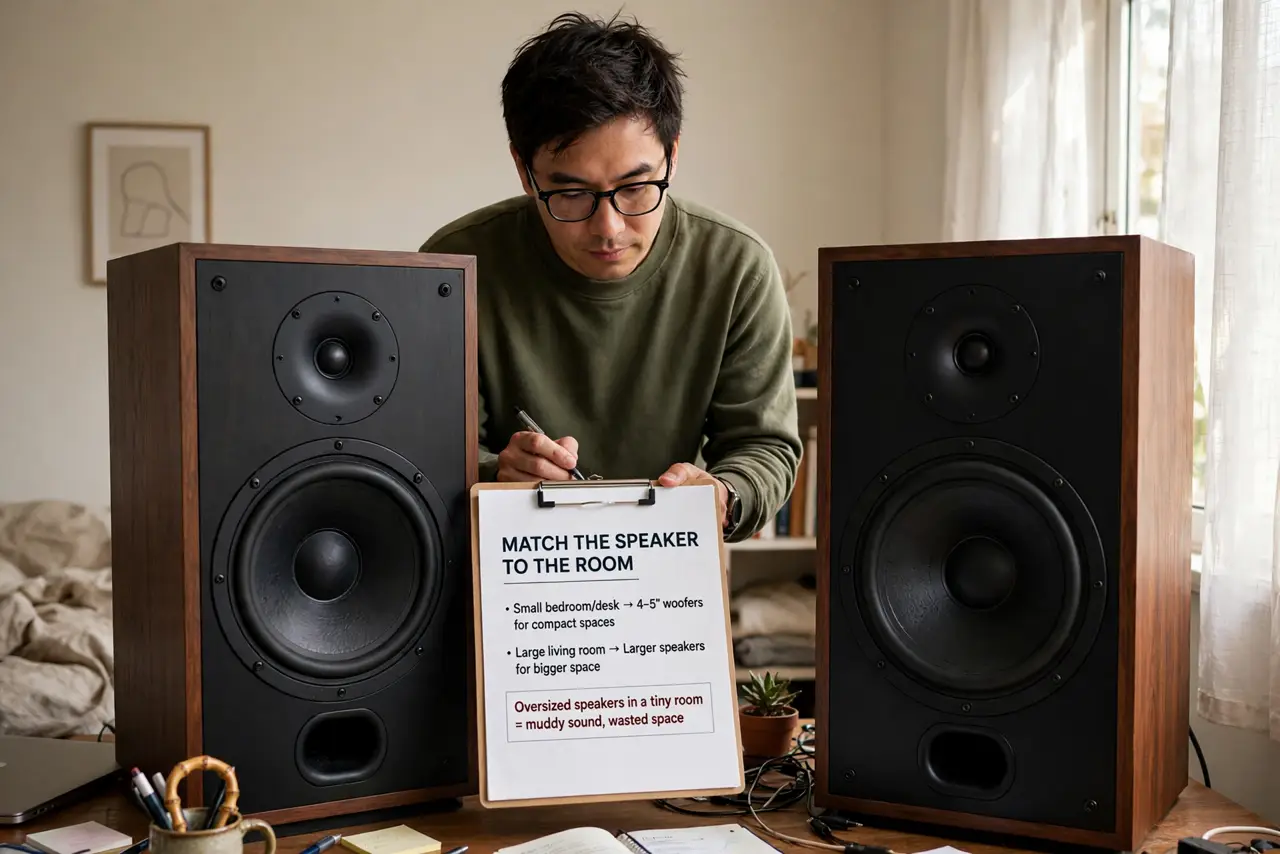
- Match the speaker to the room. A desk or small bedroom needs compact speakers with 4–5 inch woofers; a big living room wants larger ones. Oversized speakers in a tiny room sound boomy, not impressive — size to the space, not the ego.
- Decide: powered or passive. Powered speakers have the amplifier built in — one purchase, plug and play, perfect for a first pair. Passive speakers need a separate amplifier, which adds cost and complexity you do not need yet.
- Read reviews, ignore wattage. Wattage numbers are marketing more than music. What matters: clear voices, balanced bass, no harshness at volume. Trusted review sites and long-term owner reviews beat spec sheets every time.
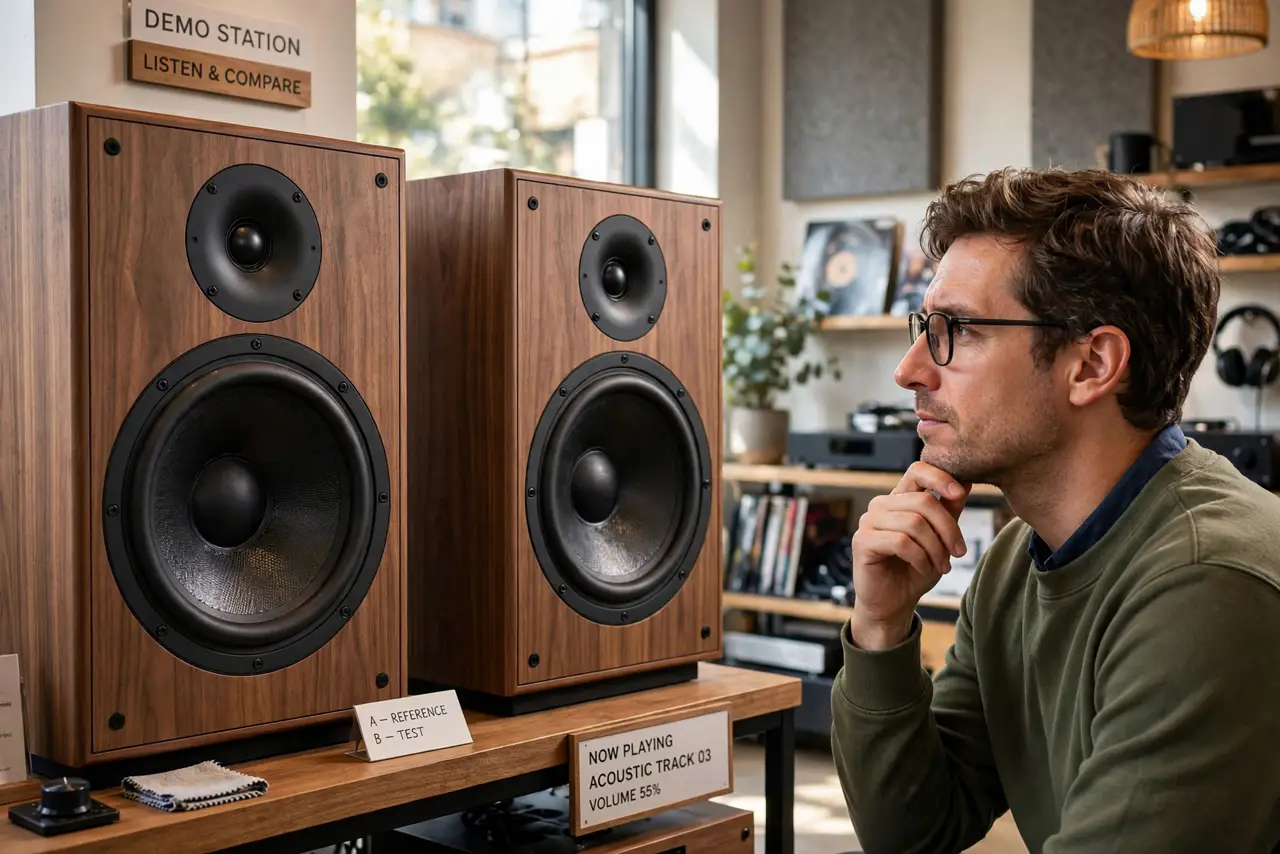
- Listen with familiar music. Bring tracks you know by heart — a voice you recognize, a bass line you know. If familiar music sounds wrong, the speakers are wrong for you, whatever the reviews say.
- Buy where returns are easy. Speakers sound different in your room than in any store. A 30-day return window is part of the purchase — it is how you audition properly.
- Position before judging. Give any new pair a fair trial with proper placement: ear height, away from walls, aimed at your seat. Half of all 'these speakers sound bad' verdicts are really placement verdicts.
What NOT to do
- Do not buy on wattage alone. A well-designed 30-watt speaker embarrasses a sloppy 200-watt one — watts are not quality.
- Do not skip the return window check. No easy returns means you are marrying the first pair you try — a bad bet for beginners.
- Do not place them and declare them bad in ten minutes. Speakers need proper positioning and a few hours of listening before judgment.
- Do not buy a subwoofer first. Get the main pair right, live with it, and only add bass if the music actually asks for it — see subwoofer placement when that day comes.
Frequently asked questions
How much should a first pair cost?
The sweet spot is a well-reviewed budget-to-midrange pair — enough for real quality, not so much that mistakes hurt. Below that, tiny plastic speakers disappoint; far above, you are paying for refinements beginners cannot hear yet.
Do I need an amplifier too?
Only with passive speakers. Powered (active) speakers include amplification — for a first purchase, powered keeps everything simple.
What about a soundbar instead?
Soundbars suit TV dialogue in tight spaces. For music, a real stereo pair images better and upgrades more gracefully — different tools for different jobs.