Review Weekly Wins
You worked all week and feel like you accomplished nothing. The work happened — it just vanished into the blur of days, because nobody stopped to look at it. A fifteen-minute weekly review makes progress visible again: wins written down, stalls named, next week aimed. It pairs perfectly with a weekly energy audit.

TL;DR / Quick Fix
Quick fix: spend 15 minutes each Friday writing down three to five wins from the week — finished tasks, progress, problems solved. Progress feels invisible because you never stop to look at it. Keep the list somewhere visible; on hard weeks it is proof you're moving.
Follow these steps
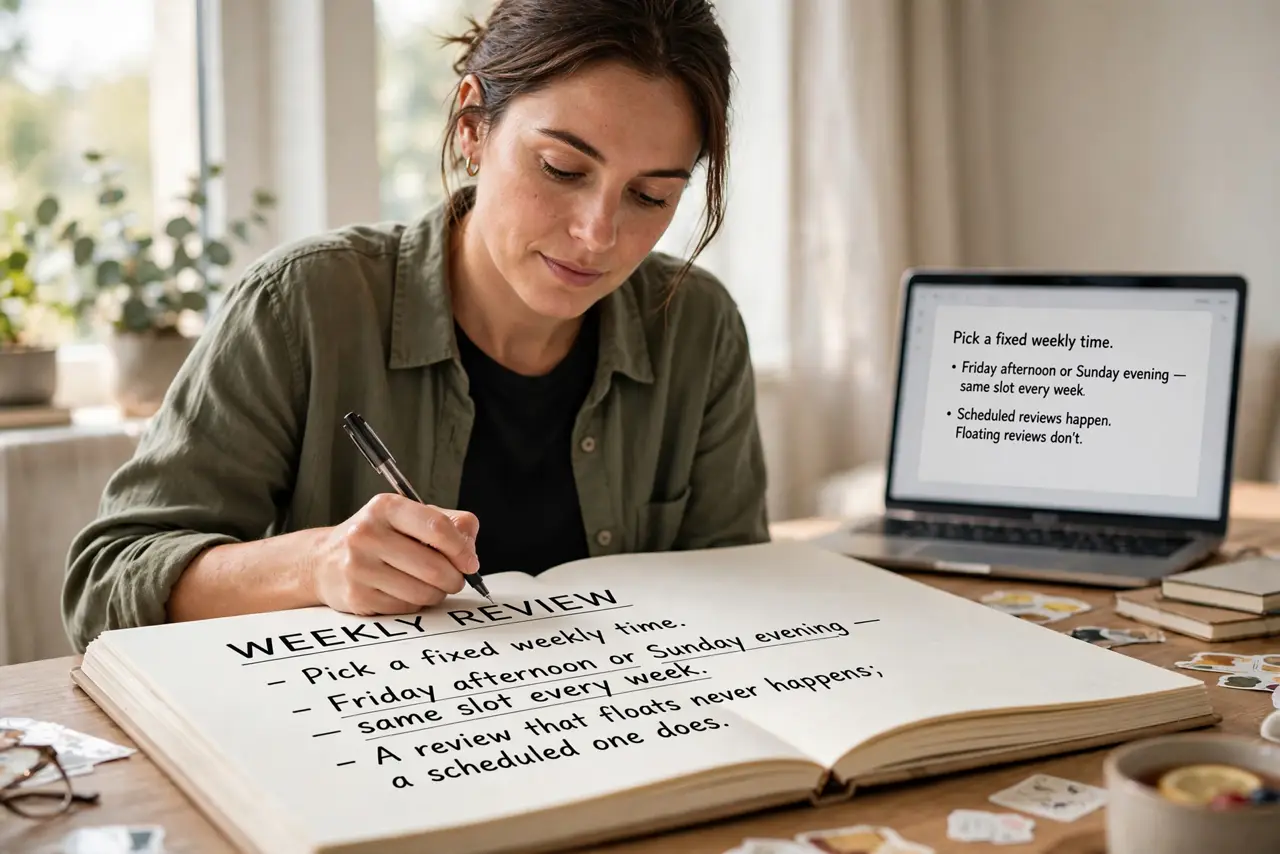
- Pick a fixed weekly time. Friday afternoon or Sunday evening — same slot every week. A review that floats never happens; a scheduled one does.
- List three to five wins. Write what got finished, what moved forward, what problem got solved. Small counts: “fixed the billing bug” is a win, not just launches.
- Name what stalled. One or two honest lines about what did not move and why. No self-flagellation — the point is information, not punishment.
- Carry forward deliberately. Move unfinished items to next week's plan on purpose, or drop them. “Carry forward by default” is how lists become graveyards.
- Note one lesson. A single sentence: what did this week teach you? Over months, these sentences become a personal playbook.
- Keep the lists visible. A running doc or a notebook page you can flip back through. On the hard weeks, the archive is the proof that you are moving.
What NOT to do
- Do not turn it into an hour-long audit. Fifteen minutes, six prompts, done — long reviews get skipped.
- Do not list only big wins. Small finished tasks are the actual texture of progress; big launches are rare.
- Do not use it to beat yourself up. A review that feels like punishment gets abandoned by week three.
- Do not skip the stalled section. Naming blockers is what turns next week from a repeat into progress.
Frequently asked questions
What if I had a terrible week?
Then the review matters most — write the one small thing that worked. Evidence beats feelings on bad weeks.
Digital or paper?
Whichever you will actually open. A notebook on the desk beats a perfect app you never launch.
How is this different from journaling?
It is structured and forward-looking: wins, stalls, lessons, next week. Journaling is freeform; this is a system.