Run a Project Kickoff
Every messy project started the same way: someone said 'let's just get going' and nobody wrote down what 'done' means, who decides what, or when it is due. A kickoff meeting — one focused hour before real work starts — prevents months of drift. It is not bureaucracy; it is the cheapest hour a project will ever spend.

TL;DR / Quick Fix
Quick fix: run a one-hour kickoff before any project starts — align on the goal, the definition of done, who decides what, and the first milestones. Write it all in one shared doc during the meeting. Skipping this costs weeks of rework later.
Follow these steps
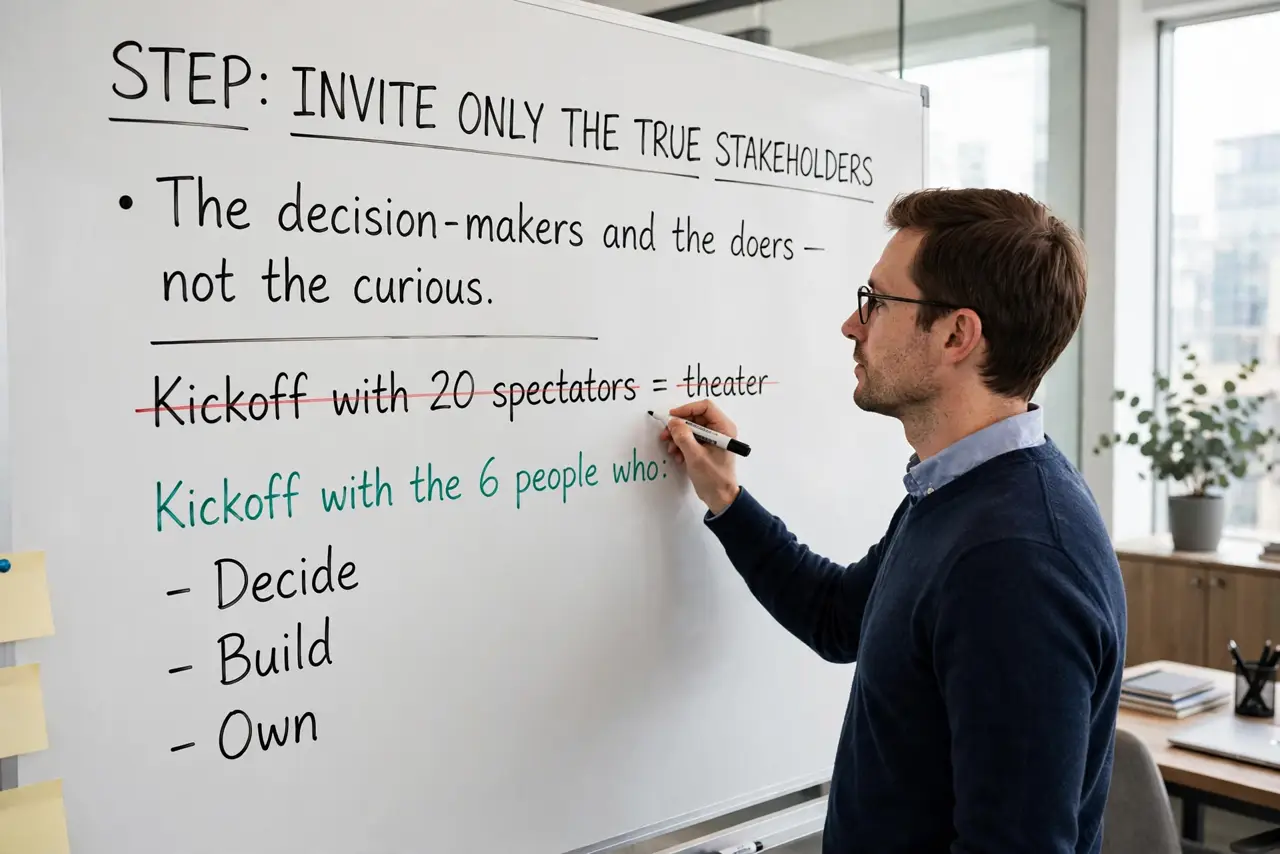
- Invite only the true stakeholders. The decision-makers and the doers — not the curious. A kickoff with twenty spectators produces theater; one with the six people who matter produces decisions.
- State the goal in one sentence. If the goal does not fit one sentence, it is not clear yet. Spend the first ten minutes until everyone can say it the same way — misalignment here compounds for months.
- Define done explicitly. What does finished look like, and how will you know? Write the definition of done in the shared doc — vague endings are where projects go to stall.
- Clarify who decides what. Every recurring decision needs a named decider. A RACI pass takes fifteen minutes and prevents the 'I thought you were handling it' collapse.
- Set the first milestones, not the whole plan. Agree on the first two or three checkpoints with dates. Detailed plans for month six are fiction; near-term milestones are commitments.
- Write it down live. Capture goal, done-criteria, roles, and milestones in one shared doc before anyone leaves. A kickoff with no written record is just a pleasant conversation.
What NOT to do
- Do not skip the kickoff to 'save time.' The hour you save becomes weeks of rework when the goal was never actually shared.
- Do not let the kickoff become a status meeting. It is about the future — decisions and commitments — not updates on other work.
- Do not invite everyone 'just in case.' Spectators dilute decisions; brief the curious afterward with the doc.
- Do not leave without written commitments. Verbal agreements evaporate; the shared doc is the project's memory.
Frequently asked questions
How long should a kickoff be?
One focused hour for most projects. Complex ones may need ninety minutes; beyond that, split it — attention is the constraint.
What if stakeholders cannot all attend?
Hold it with who matters most, then get explicit sign-off from absentees on the written doc. Silence is not agreement — get the yes in writing.
Do small projects need a kickoff?
A fifteen-minute version, yes. Goal, done, decider, first milestone — even tiny projects drift without those four lines.