'No Logs' VPN Claims? Explained
Every VPN says 'no logs' — and the phrase means wildly different things depending on who is saying it. Some keep nothing; some keep connection times, bandwidth totals, or your real IP 'temporarily.' Here is how to read past the marketing and judge a provider's actual logging policy.

TL;DR / Quick Fix
'No logs' is marketing, not a standard — providers differ on timestamps, bandwidth records, and account data they keep. Read the privacy policy's logging section, look for independent audits and court-tested claims, and prefer providers with RAM-only servers. Free VPNs always log the most, since your data is their business.
Follow these steps
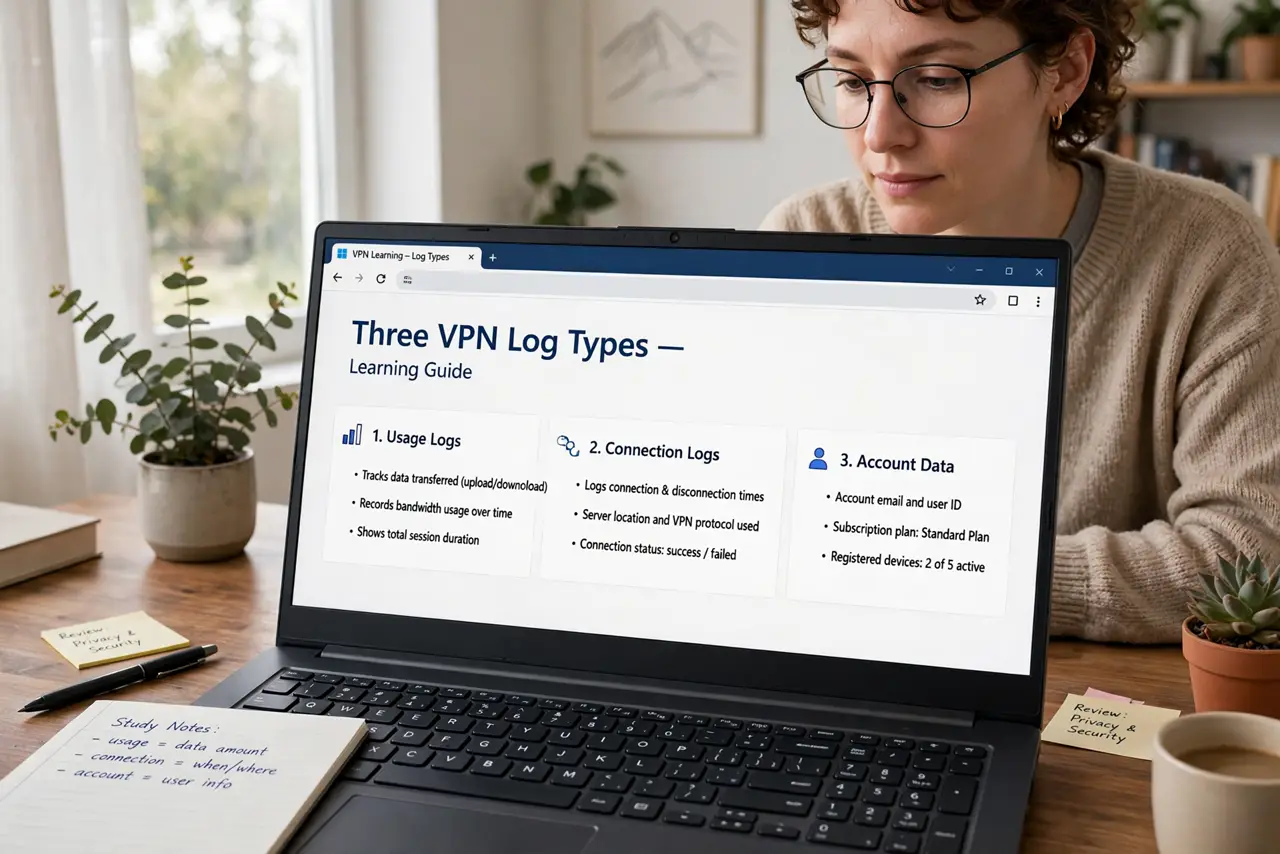
- Learn the three log types. Usage logs (what you did), connection logs (when and how much), and account data (who pays). 'No logs' should mean none of the first two.
- Read the actual privacy policy. Search the policy for 'log.' Vague phrasing like 'we may collect' next to a 'no logs' homepage is a red flag.
- Look for independent audits. Reputable security firms audit some providers' no-logs claims. Check the audit's date — old audits prove old practices.
- Check for court-tested claims. A provider that proved it had no logs to hand over under legal pressure offers the strongest real-world evidence.
- Consider jurisdiction. Where the company legally sits determines which governments can compel it. Privacy-friendly jurisdictions are a plus, not a guarantee.
- Treat free VPNs as the product being you. Running servers costs money. Free providers monetize somehow — usually your data. See the free VPN risks breakdown.
What NOT to do
- Do not trust 'no logs' on the pricing page alone. The privacy policy is the binding document; marketing copy is not.
- Do not assume an audit from years ago still applies. Infrastructure and ownership change.
- Do not pay with an identity-linked card if anonymity matters to you. Check what payment data the provider retains.
- Do not confuse a VPN with invisibility. A VPN shifts trust from your internet provider to the VPN company — choose who you trust deliberately.
Frequently asked questions
What does 'RAM-only servers' mean?
Servers that run entirely in memory, so a reboot wipes everything. There is nowhere for logs to persist even if someone seizes the machine.
Can a VPN see my traffic?
It can see metadata like timing and volume. HTTPS still hides page contents from everyone, VPN included.
Is a court test the gold standard?
It is the strongest real-world evidence: a provider that could not produce logs when legally compelled is telling the truth.