AIO or Air Cooler?
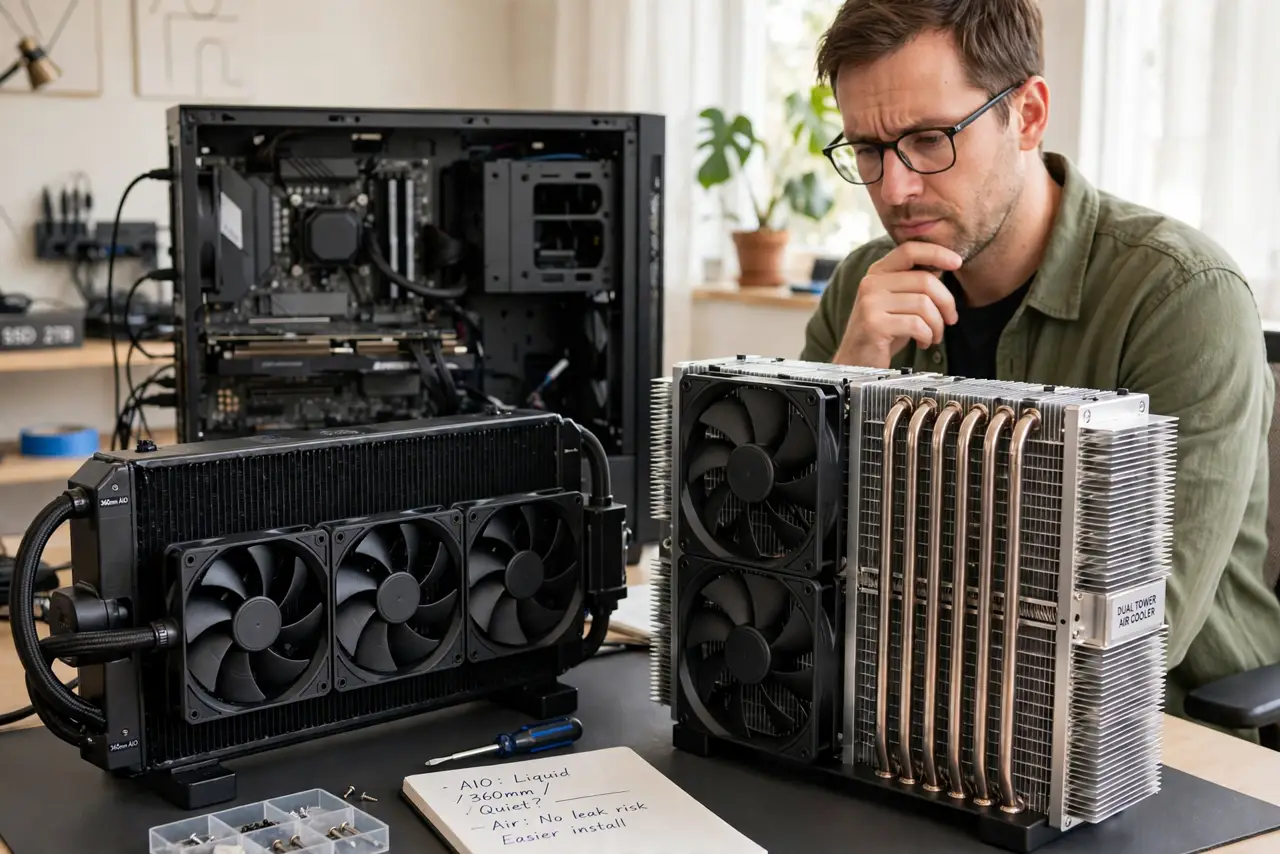
Shopping for CPU cooling, you face the fork: a sleek liquid AIO with its glowing pump, or a big honest tower of fins and fans. AIOs look high-tech; air coolers look old-school — but the performance gap is smaller than the marketing suggests, and reliability points the other way. Here is the real tradeoff.
TL;DR / Quick Fix
Quick fix: a quality tower air cooler matches most 240mm AIOs in cooling, costs less, and cannot leak or suffer pump failure. Choose an AIO for top-tier CPUs in hot cases, or for the looks. For everyone else, a good air cooler is the smart money.
Follow these steps
- Learn what each does. An air cooler is a big heatsink with fans — heat pipes move heat to fins, fans blow it away. An AIO is a sealed liquid loop — liquid carries heat to a radiator, fans cool the radiator. Same job, different plumbing.
- Compare real performance. A good dual-tower air cooler roughly equals a 240mm AIO on most CPUs. AIOs pull ahead at 280mm and above, or on the hottest flagship chips — everywhere else it is a tie with a price gap.
- Weigh reliability. Air coolers have one moving part type: fans, cheap and replaceable. AIOs add a pump — when it dies years in, the whole unit is replaced. Air cooling fails gracefully; liquid fails totally.
- Check your case fit. Tower coolers need vertical clearance — measure your case's max cooler height. AIOs need radiator mounting spots — check which sizes your case supports. Fit decides before performance does.
- Consider noise honestly. Both can be quiet; both can roar. AIOs add pump hum to the fan noise equation. Read noise-normalized reviews — the quietest option at equal cooling is what matters, not the technology.
- Factor the looks. AIOs look clean with their small CPU block and RGB fans; big air towers dominate the case interior. If the build sits on your desk behind glass, aesthetics are a legitimate factor.

What NOT to do
- Do not buy a 120mm AIO over a good air cooler. Small AIOs lose to mid-range towers while adding pump risk — the worst of both worlds.
- Do not assume liquid always wins. At equal price, air usually cools as well or better — liquid's edge needs radiator size to show.
- Do not ignore pump noise. AIO pumps hum at a frequency fans do not mask — check reviews specifically for pump acoustics.
- Do not mount the radiator wrong. Tubes-down or top-mounted keeps air away from the pump — a poorly mounted AIO gurgles and dies early.
Frequently asked questions
Do AIOs leak?
Modern sealed units very rarely do — but 'rarely' is not 'never,' and a leak's consequences exceed a fan failure's. Air coolers cannot leak at all.
How long do AIOs last?
Pumps typically run five to seven years. Budget for replacement in a long-lived build; air coolers last decades with a fan swap.
Which is better for overclocking?
Big AIOs — 280mm and up — give overclockers the most thermal headroom. For stock or mild boosts, air is plenty.