Audit Your Energy
Some tasks leave you buzzing, others hollow you out — yet your calendar treats them as identical blocks. That mismatch is why days feel exhausting without being productive. An energy audit maps which tasks drain you and when your energy peaks, so you can schedule with biology instead of against it. Review the results in your weekly review.
TL;DR / Quick Fix
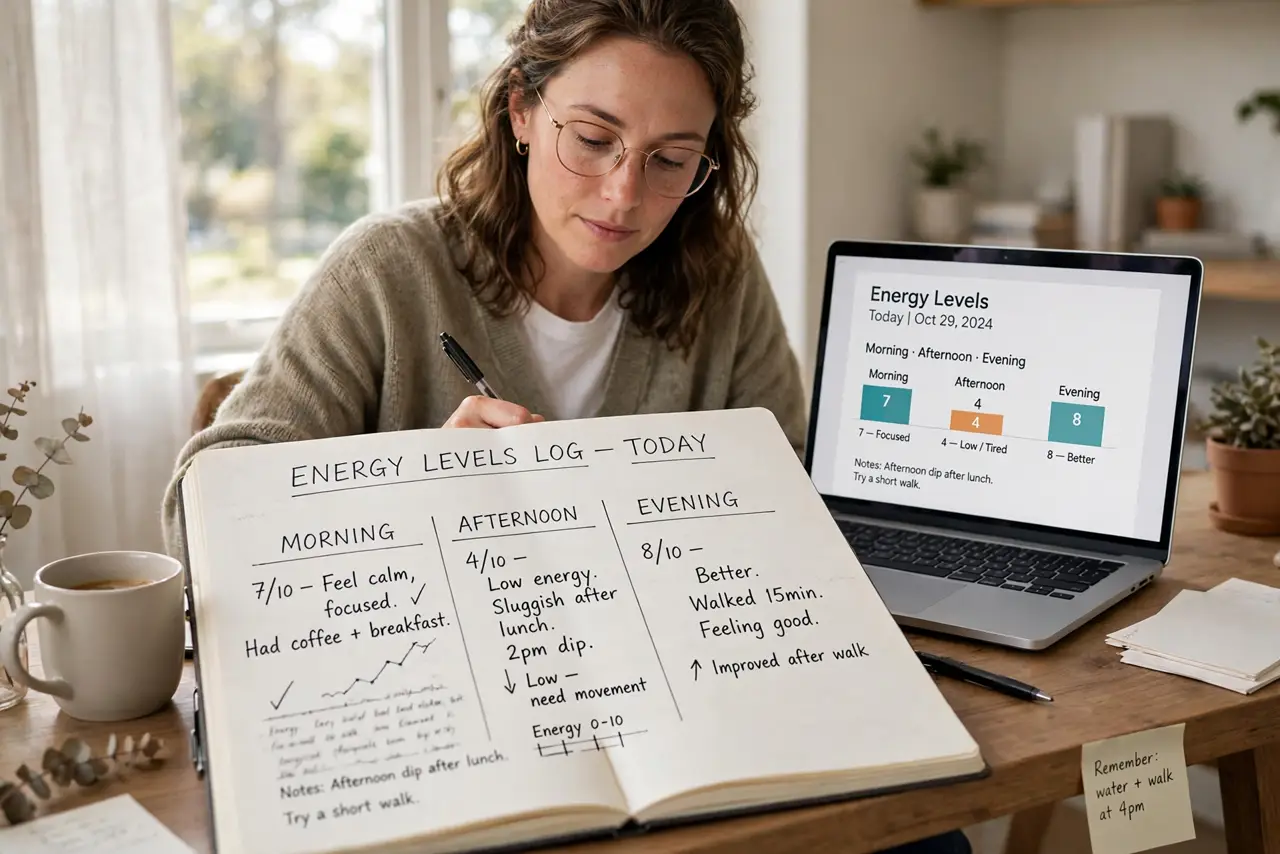
Quick fix: for three days, jot down your energy level morning, afternoon, and evening alongside what you were doing. You'll see your real peaks — schedule hard work there and shallow tasks in the dips. Stop fighting your biology; design the day around the energy you actually have.
Follow these steps
- Track energy three times daily. Morning, afternoon, evening — rate energy 1 to 5 and note what you were doing. Three days is enough to see patterns; a week is better.
- Rate tasks by drain, not time. A 30-minute difficult call can drain more than three hours of easy admin. Mark each recurring task high, medium, or low drain — time and energy are different currencies.
- Find your peaks. Most people peak mid-morning or late evening; almost nobody peaks right after lunch. Your data beats generic advice — trust the three days.
- Schedule hard tasks at peaks. Move deep, creative, or difficult work into your high-energy windows. This one change outperforms most productivity systems.
- Batch draining tasks together. Group the draining stuff into one contained block rather than sprinkling it through the day — see batching shallow tasks for the technique.
- Protect recovery deliberately. Schedule real breaks after high-drain blocks. Recovery is not laziness; it is the other half of the energy equation.

What NOT to do
- Do not confuse hours with energy. Ten low-energy hours produce less than four high-energy ones — plan around peaks, not clocks.
- Do not audit once and file it away. Energy patterns shift with seasons, sleep, and stress — re-audit quarterly.
- Do not schedule difficult tasks in your dip “for discipline.” Discipline cannot override biology; it just produces bad work slowly.
- Do not skip the recovery step. An audit without scheduled recovery is just a fancier way to burn out.
Frequently asked questions
What if my peaks are at odd hours?
Then protect those hours fiercely — night-owl peaks are real. Shift what you can; negotiate what you cannot.
How is this different from time tracking?
Time tracking logs hours; energy auditing logs how you felt. Both useful, completely different data.
I have no control over my schedule — pointless?
Not at all. Even knowing your dip lets you save easy tasks for it instead of fighting hard ones there.