Cat5e vs Cat6 vs Cat6a?
Shopping for ethernet cable, you face an alphabet soup: Cat5e, Cat6, Cat6a — each promising more speed for more money. The categories describe how much data the cable can carry and how far, and for most homes the answer is simpler than the marketing suggests. Here is what each one actually buys you before you run cable.
TL;DR / Quick Fix
Quick fix: buy Cat6 for new runs — it handles gigabit easily and supports 10-gigabit over short distances, costing barely more than Cat5e. Cat5e is fine if you already own it. Cat6a only matters for full 100-meter 10-gigabit runs, which almost no home needs.
Follow these steps
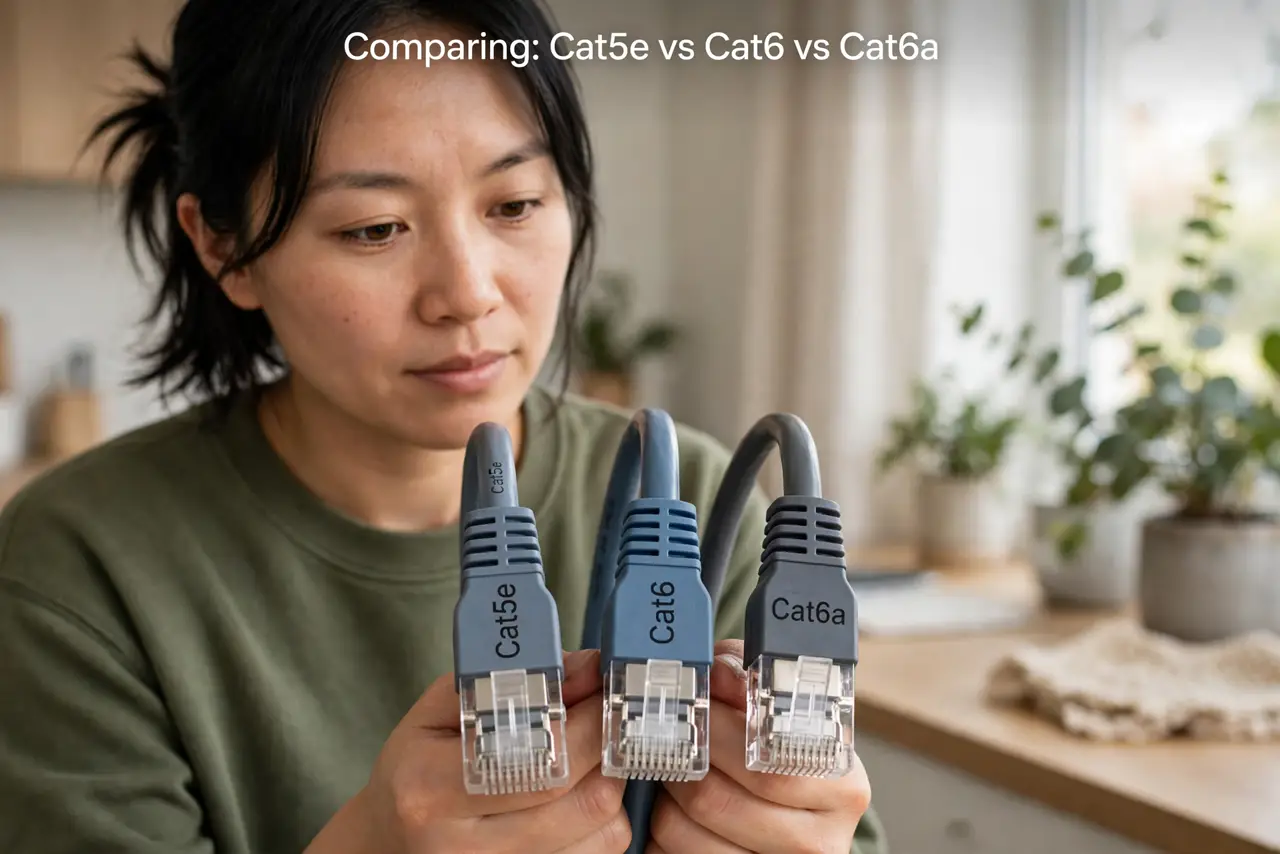
- Learn what Cat5e does. Cat5e (the “e” is for enhanced) reliably carries gigabit ethernet to the full 100 meters. It is the minimum you should buy today — and perfectly fine if you already have it in the walls.
- Learn what Cat6 adds. Cat6 is built to tighter specs with better crosstalk protection. It carries gigabit effortlessly and supports 10-gigabit up to 55 meters — plenty for any home run.
- Learn what Cat6a is for. Cat6a (augmented) carries 10-gigabit the full 100 meters. It is thicker, stiffer, and pricier — built for offices and data closets, not living rooms.
- Buy Cat6 for new runs. The price gap over Cat5e is small, and Cat6 covers every realistic home need including short 10-gigabit runs. It is the no-regrets default.
- Do not overbuy. Cat6a and Cat7 in a home are money spent on capability you will never use. Spend the difference on a better switch or router instead.
- Check the printed rating. Real cable has its category printed along the jacket. No print, no guarantee — unmarked cable is where “Cat6” disappoints.

What NOT to do
- Do not buy Cat5 (no “e”) anymore. Plain Cat5 is obsolete stock — Cat5e is the minimum worth installing.
- Do not assume flat means Cat6. Many flat cables are unshielded Cat5e regardless of the listing title — check the jacket print.
- Do not pay a big premium for Cat7 at home. The standard is not even recognized the same way, and your gear cannot use it.
- Do not mix up cable and speed. Your internet plan and router decide your speed; the cable just needs to not be the bottleneck.
Frequently asked questions
Is Cat6 faster than Cat5e for my internet?
Only if your plan exceeds gigabit — otherwise both deliver your full speed identically.
Can I mix Cat5e and Cat6 in one network?
Yes. Each run performs to its own rating; mixing is completely fine.
How far can I run each?
100 meters for gigabit on all of them — see the length limits for the 10-gigabit exceptions.