How Long Can Ethernet Run?
You need to wire the far end of the house — or the detached garage — and the worry creeps in: how long is too long for an ethernet cable? The official answer is a clean number with a few important footnotes about speed, cable type, and what to do past the limit. Read this before you run cable.
TL;DR / Quick Fix
Quick fix: ethernet runs reliably up to 100 meters (328 feet) for gigabit — plenty for any home. Past that, signals degrade; add a switch midway as a repeater or switch to fiber. Cat6 handles 10-gigabit only to 55 meters, so plan faster runs shorter.
Follow these steps
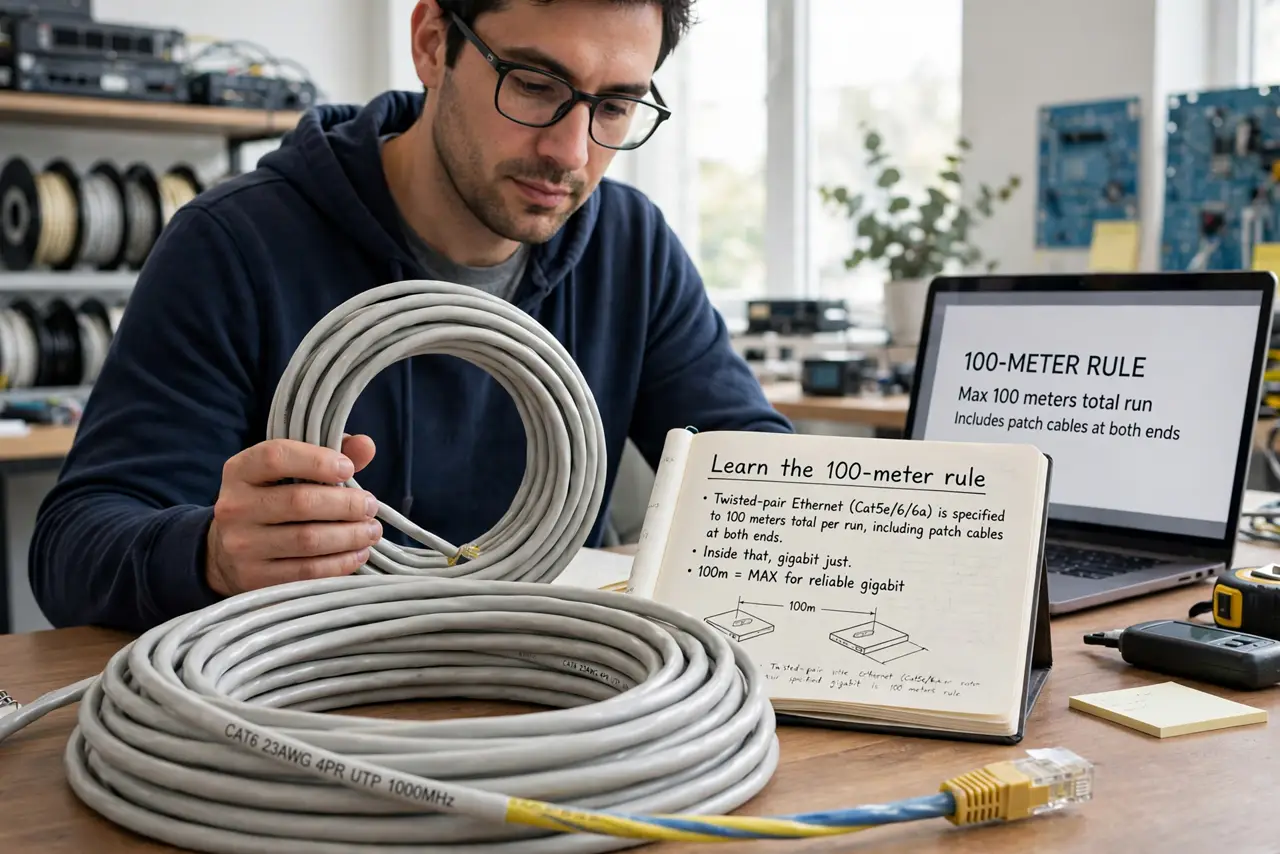
- Learn the 100-meter rule. Twisted-pair ethernet (Cat5e/6/6a) is specified to 100 meters total per run, including patch cables at both ends. Inside that, gigabit just works.
- Understand why the limit exists. It is about signal timing, not just weakening — beyond 100 meters the round-trip timing the protocol relies on breaks down. Longer is not “slower,” it is unreliable.
- Note the 10-gigabit exceptions. Cat6 carries 10-gigabit only to 55 meters; Cat6a goes the full 100. If you are planning multi-gigabit, see Cat5e vs Cat6 vs Cat6a before buying.
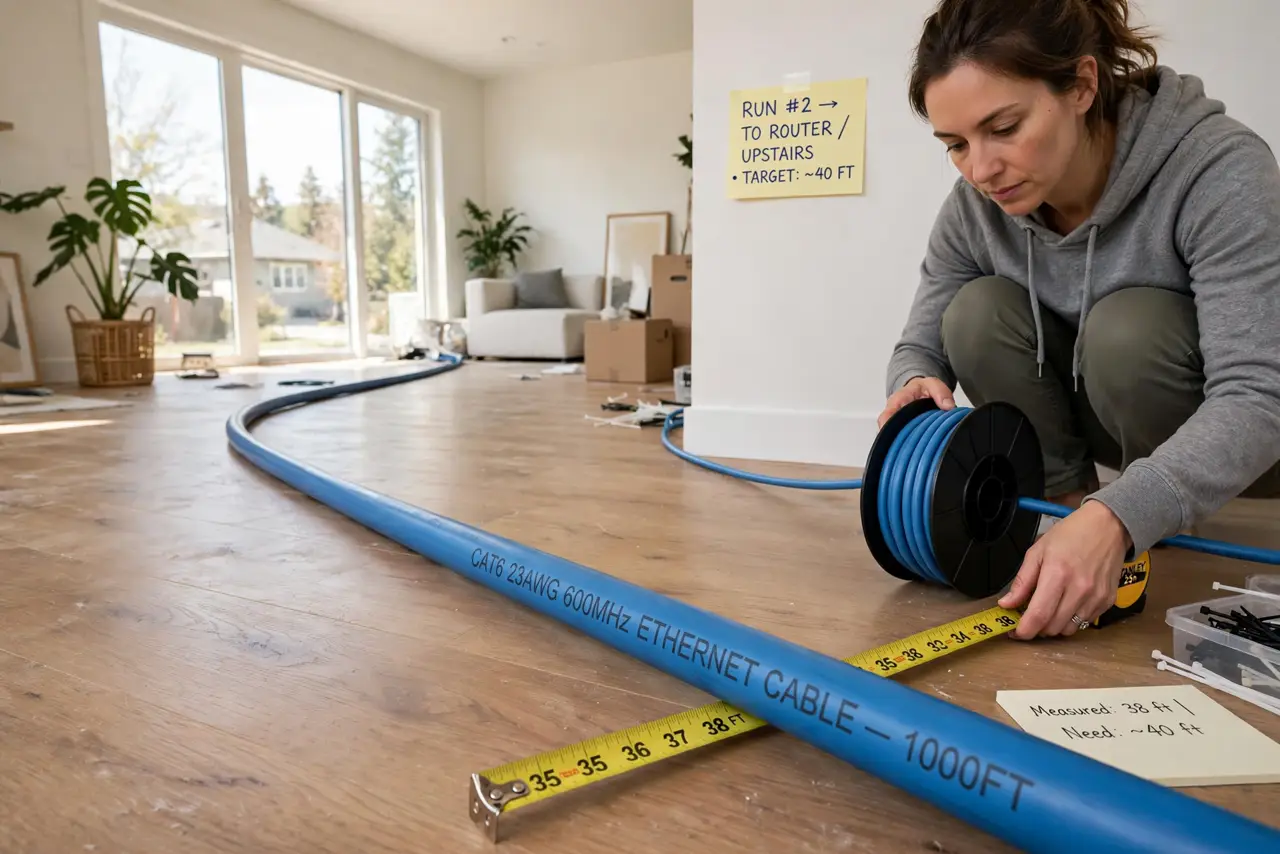
- Measure before buying. Walk the actual route — up, around, through — not the straight-line distance. Most “too long” fears evaporate at 20–30 real meters.
- Past 100m: add a switch. A cheap switch at the midpoint acts as a repeater, giving you another full 100 meters. It needs power at that spot — which is where Power over Ethernet can help.
- Past 300m: think fiber. For outbuildings far away, pre-terminated fiber with media converters beats heroic copper runs — immune to lightning-induced surges too.
What NOT to do
- Do not assume longer cable means slower speed. Within spec, a 90-meter run is exactly as fast as a 2-meter one.
- Do not join cables with barrel couplers casually. Each join is a failure point; one continuous run beats three coupled segments.
- Do not forget patch cables count. The 100 meters includes the short cables at both ends — budget a few meters for them.
- Do not run copper between buildings without protection. Lightning-induced surges travel copper; fiber or proper surge protection for inter-building runs.
Frequently asked questions
My run is 120 meters — will it work?
Maybe, unreliably. It might link at reduced speed or drop under load — a midpoint switch is the proper fix.
Does cable quality extend the limit?
No — the 100-meter spec already assumes proper cable. Better cable improves 10-gigabit reach, not the gigabit limit.
What about PoE distance?
Same 100-meter limit — power and data travel together. See Power over Ethernet for the power side.