Define Done Clearly
You have been 'almost done' with the report for three days — tweaking, second-guessing, adding one more section. The work never feels finished because 'finished' was never defined. A clear definition of done, written before you start, turns the endless 90% into a checklist you can actually complete. It is the simplest productivity tool there is.

TL;DR / Quick Fix
Quick fix: before starting any task, write down exactly what 'done' looks like — the deliverable, its quality bar, and what is explicitly out of scope. When every box is checked, you stop. Vague endings breed endless polishing; a written definition turns 'almost done' into done.
Follow these steps
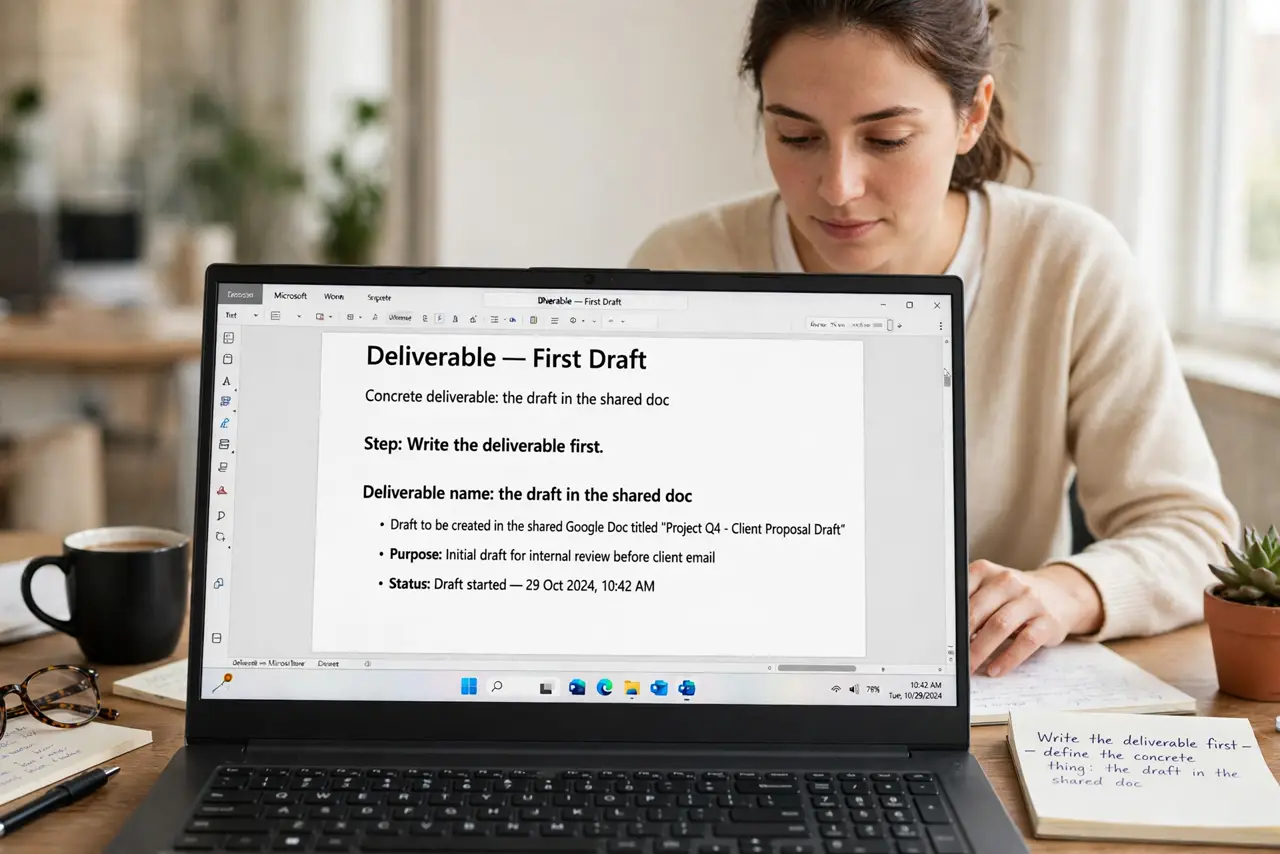
- Write the deliverable first. Name the concrete thing that will exist: 'the draft in the shared doc,' 'the email sent to the client.' If you cannot name it, you cannot finish it.
- Set the quality bar explicitly. 'Good enough to send' versus 'polished for publication' are different finishes. Write which one this task needs — most endless polishing comes from an unspoken bar set at perfection.
- List what is out of scope. Write what done does NOT include. 'Done excludes the appendix and the redesign' kills the creeping urge to add just one more thing.
- Make it checkable. Turn the definition into 3–5 checkbox items. Checkboxes are finishable; vibes are not. The physical act of checking is the psychological finish line.
- Agree it with stakeholders upfront. If someone else judges the work, get their sign-off on the definition before starting. Surprise criteria at the end are how 'done' un-dones itself.
- Use it in reviews. When reviewing progress — your own or a team's — open with the definition. The weekly review is a natural place to check definitions against reality.
What NOT to do
- Do not start without writing it down. A definition of done that lives in your head morphs the moment the work gets hard.
- Do not define done as 'perfect.' Perfection is not a finish line — it is a treadmill. Name the real bar.
- Do not let others move the goalposts silently. New criteria need explicit agreement, or 'done' becomes a moving target.
- Do not confuse activity with completion. Hours spent are not done; the named deliverable, checked off, is done.
Frequently asked questions
Is this just procrastination advice?
No — it is scope control. Procrastination delays starting; undefined done-ness prevents finishing. Different problems, same cure: write it down.
What if the work genuinely needs expanding?
Then redefine done explicitly and note why. Conscious scope change is fine; unconscious creep is the enemy.
Does this work for creative work?
Yes, with a bar like 'three drafts reviewed' instead of 'brilliant.' Process-based definitions finish creative work; quality-based ones paralyze it.