Mix Up Study Topics
You reread the chapter, it feels familiar, you close the book feeling ready — and the test exposes that you knew nothing. That fluency illusion is the trap: rereading feels like learning because recognition is easy. Mixing up topics breaks the illusion by forcing your brain to choose the right approach each time, which is exactly what tests demand.
TL;DR / Quick Fix
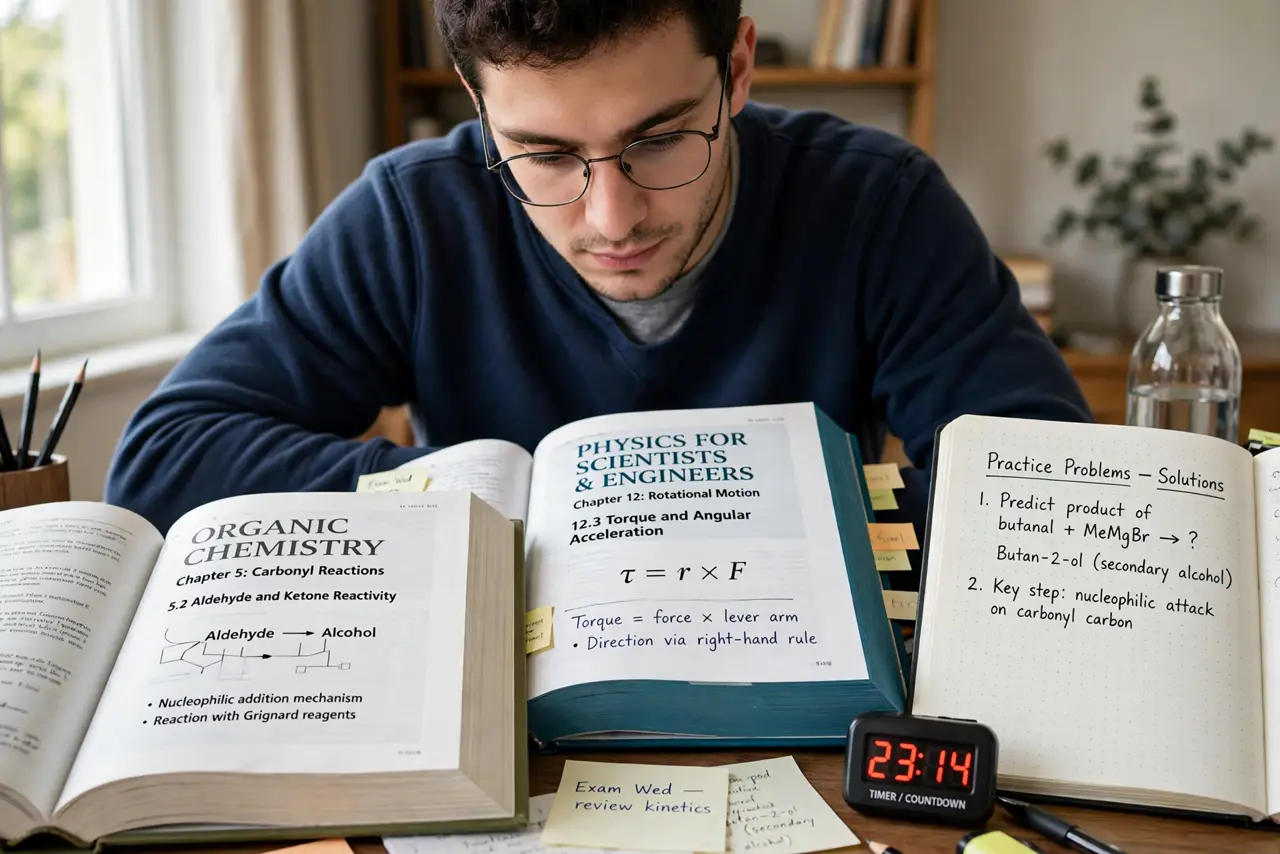
Quick fix: stop studying one topic in a solid block. Shuffle topics so each session jumps between subjects — ten minutes of algebra, ten of history, ten of vocabulary. It feels harder and slower, but that effort builds flexible recall. Pair it with self-testing for the full effect.
Follow these steps
- Notice the fluency trap. Rereading and highlighting feel productive because the material looks familiar. That familiarity is recognition, not recall — and tests ask for recall.
- Break your material into small topic chunks. Split each subject into bite-size pieces — individual concepts, problem types, or vocabulary sets. Small chunks are what you will shuffle.
- Shuffle the order every session. Deal the chunks like cards: a bit of topic A, then C, then B, never the same sequence twice. The unpredictability forces your brain to reload each skill from scratch.
- Switch subjects, not just subtopics. The strongest version mixes whole subjects — math, then language, then science. Cross-subject switching trains the which-tool-do-I-use judgment that single-topic blocks never touch.
- Test yourself at each switch. Before moving to the next chunk, close the book and recall the key points of the one you just did. Mixing plus active recall is the combination that actually sticks.
- Track what the mixing reveals. Keep a simple log of which chunks you fumble after a switch. Those are your real weak spots — the ones block studying was hiding from you.

What NOT to do
- Do not mix before you have basic familiarity. Interleaving works on material you have seen once — shuffling total unknowns is just confusion.
- Do not confuse harder-feeling with worse learning. Mixed practice feels slower; that friction is the mechanism, not a sign it is failing.
- Do not shuffle randomly forever. Once a weak spot appears, give it a short focused block, then return it to the mix.
- Do not study mixed topics while multitasking. The switching already loads your working memory — notifications on top will sink it.
Frequently asked questions
How is this different from multitasking?
Multitasking splits attention across unrelated things. Interleaving keeps full attention on studying — it just varies what you study, which strengthens retrieval.
Will my grades drop at first?
Practice scores often dip when you start mixing, because the crutch of repetition is gone. Test scores typically rise once the retrieval strength builds.
How long should each chunk be?
Long enough to engage — roughly 10 to 20 minutes per chunk. Shorter than that and you never settle in; longer and you slide back into block mode.