Pick a Racing Wheel
Your controller works, but it will never feel like driving — no weight in the corners, no fight in the wheel, no pedals under your feet. A racing wheel changes sim racing completely, but the market spans toy-like bundles to pro-grade direct-drive rigs, and buying wrong is expensive. This guide matches the wheel to your commitment level.

TL;DR / Quick Fix
Quick fix: picking a racing wheel comes down to force feedback strength, pedal quality, and mounting — direct-drive wheels feel best but cost most, belt-driven hits the sweet spot for most. Budget for a solid mount or rig, since a wheel clamped to a wobbly desk ruins the immersion.
Follow these steps
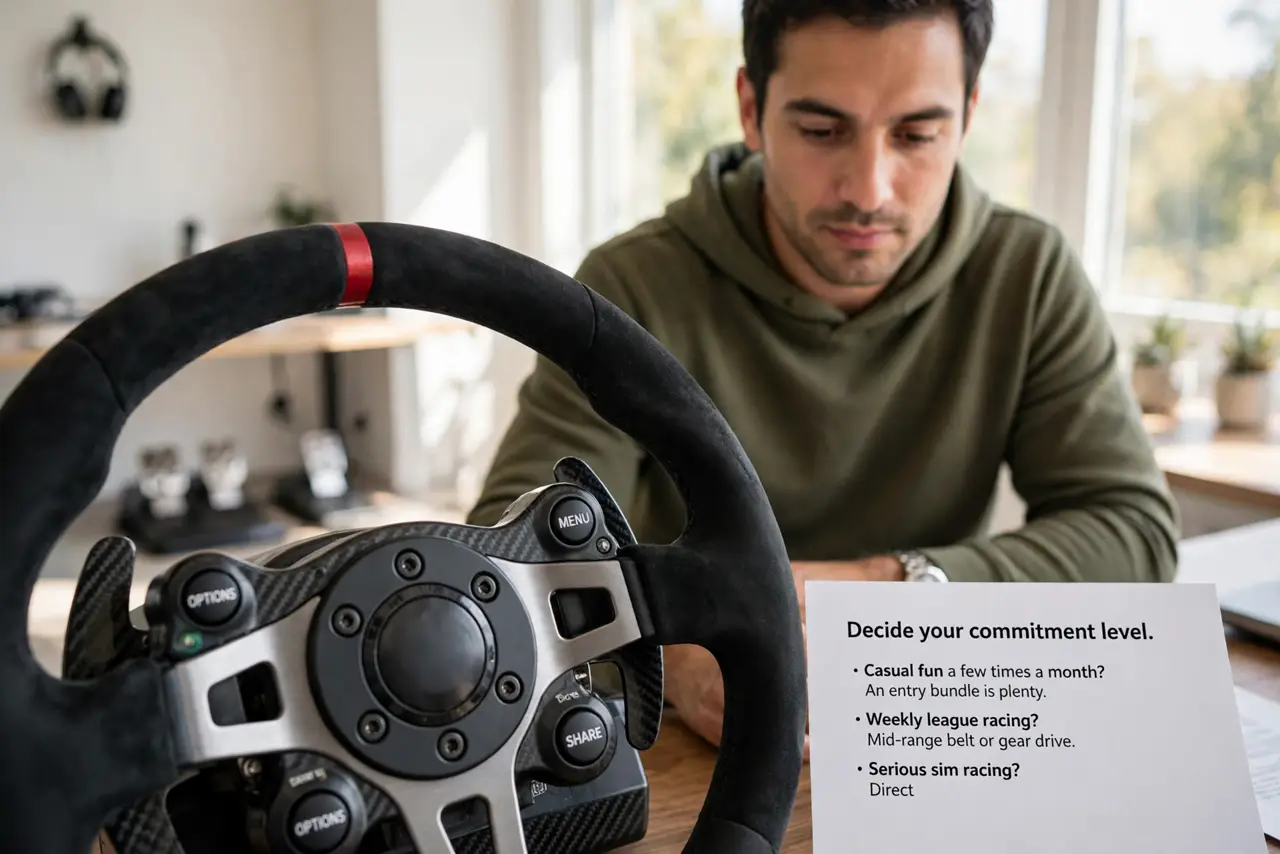
- Decide your commitment level. Casual fun a few times a month? An entry bundle is plenty. Weekly league racing? Mid-range belt or gear drive. Serious sim racing? Direct drive. Buying above your commitment wastes money; buying below it wastes the hobby.
- Understand force feedback types. Gear-driven is affordable and notchy; belt-driven is smoother and the mainstream sweet spot; direct-drive bolts the wheel to a powerful motor for the most realistic feel at the highest price. Feel scales with price honestly here.
- Do not skimp on pedals. Pedals matter as much as the wheel — a load-cell brake pedal (pressure-based, like a real car) transforms braking feel more than any wheel upgrade. Budget wheels with toy pedals are the classic regret purchase.
- Budget for mounting. A wheel clamped to a wobbling desk flexes, slides, and kills immersion. A solid wheel stand or rig is not optional furniture — it is part of the wheel purchase. Price them together from the start.
- Check game and platform compatibility. Not every wheel works with every platform — PC is universal, consoles are picky. Verify your exact wheel supports your platform and your favorite titles before ordering; the setup guide covers what comes after unboxing.
- Try before you buy if possible. Feel is personal. A sim-racing meetup, expo, or generous return policy beats a hundred reviews — ten minutes of driving tells you more than ten hours of reading.
What NOT to do
- Do not buy direct-drive as a beginner. Pro-grade torque overwhelms newcomers and empties wallets — start where your skill is, upgrade when you outgrow it.
- Do not mount a strong wheel to a weak desk. Flex and slide ruin a good wheel's feel — the mount is part of the system, not an accessory.
- Do not ignore the pedals. A great wheel with mushy pedals is half an upgrade — pedals deserve a real share of the budget.
- Do not expect plug-and-play perfection. Every wheel needs calibration, force-feedback tuning, and per-game settings — budget an evening for setup, not five minutes.
Frequently asked questions
How much should a first wheel cost?
A solid entry setup (wheel plus pedals) runs a few hundred dollars; add a stand. Below that, quality drops fast; far above, you are paying for feel beginners cannot use yet.
Can I use it on both PC and console?
Some wheels support both, many are platform-specific. Check the exact model's compatibility list — 'works with PlayStation' and 'works with Xbox' are different licenses.
Is a rig really necessary?
Not at first — a sturdy wheel stand works. But a desk clamp on a wobbly table is the fastest way to hate an expensive wheel.