Place Your Subwoofer Right
Your subwoofer arrived, you put it in the corner where it fits, and now every explosion sounds like thunder in a barrel while dialogue sounds thin. Bass is the most room-sensitive part of audio — the same subwoofer can sound tight or terrible depending on a few feet of placement. Before you blame the equipment, move it: the speaker placement basics apply here too, with a couple of bass-specific tricks.
TL;DR / Quick Fix
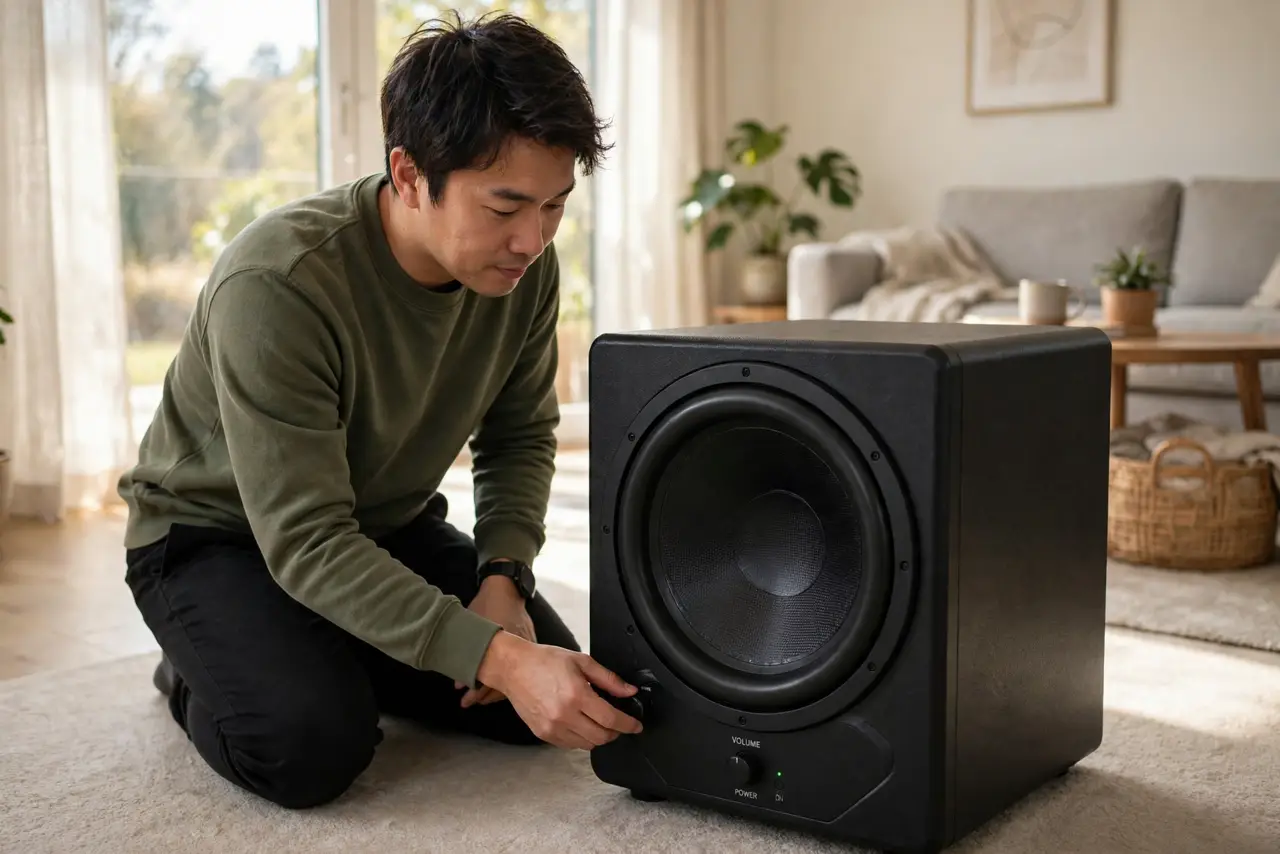
Quick fix: boomy bass usually means the subwoofer sits in a corner or against a wall — pull it out and lower the crossover until bass blends instead of booms. Try the subwoofer crawl: place it at your seat, crawl around listening, and put it where bass sounds smoothest.
Follow these steps
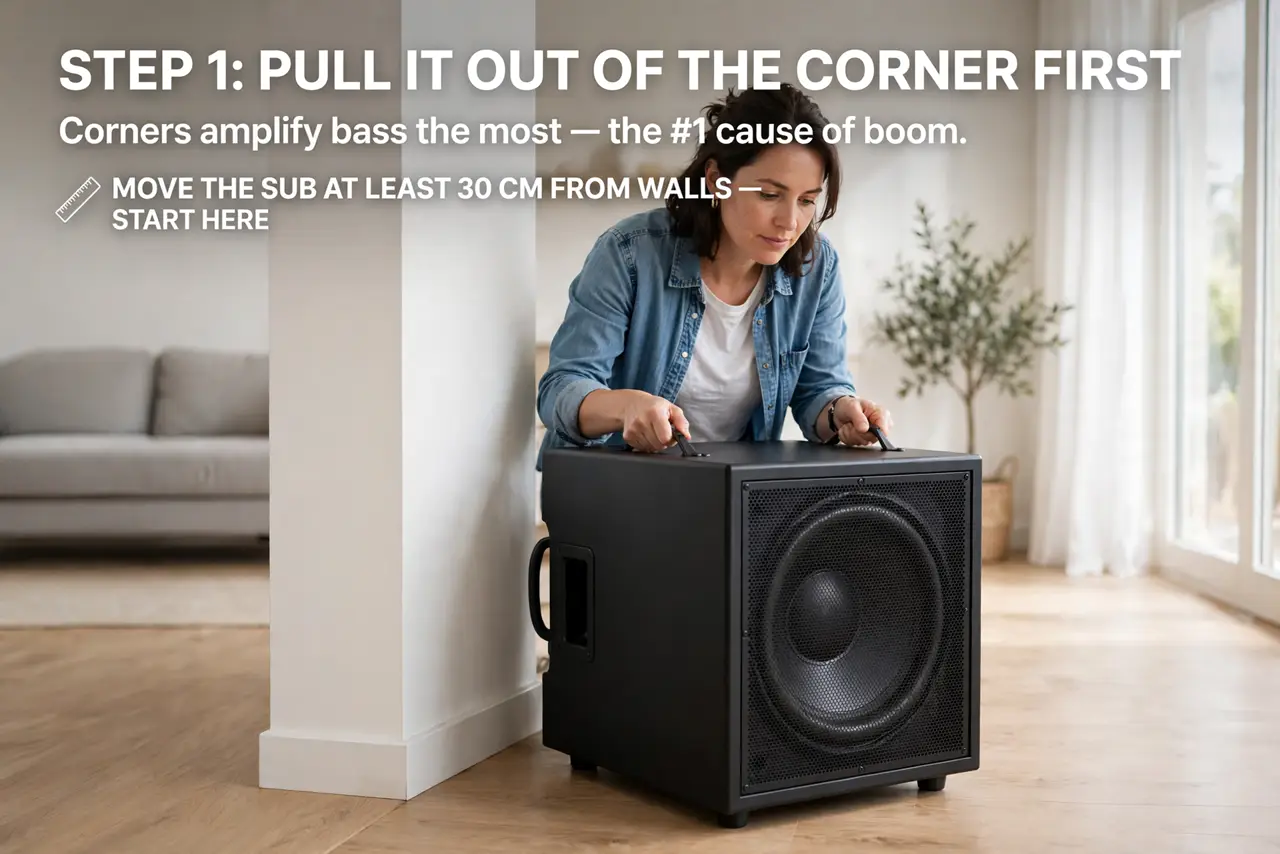
- Pull it out of the corner first. Corners amplify bass the most — convenient, and the number one cause of boom. Move the sub at least 30 cm from walls as a starting point; the boom usually drops immediately.
- Do the subwoofer crawl. Place the subwoofer in your listening seat, play bass-heavy music, then crawl around the room at subwoofer height listening. Where bass sounds smoothest and most even is where the subwoofer belongs — mark the spot.
- Set the crossover sensibly. The crossover decides where the sub takes over from the main speakers — around 80 Hz is the classic starting point. Too high and voices come from the sub; too low and there is a hole in the bass.
- Match the volume to the room, not the demo. Turn the sub up until you notice it, then back down a touch — proper bass is felt more than heard. If guests comment on the bass, it is too loud.
- Check the phase switch. A 0/180 phase toggle aligns the sub's timing with your speakers. Flip it and listen: one setting will sound fuller and more solid — keep that one.
- Re-check after moving furniture. Bass interacts with the whole room — a new sofa or bookshelf changes it. After any big room change, spend five minutes re-verifying the sub still sounds right.
What NOT to do
- Do not leave it in the corner by default. The corner is where it fits, not where it sounds best — boom is the price of convenience.
- Do not crank the volume to impress. Overwhelming bass impresses for a day and fatigues forever — blend, do not dominate.
- Do not set the crossover by guessing. Too high muddies voices; too low leaves a gap — start at 80 Hz and adjust by ear.
- Do not buy a bigger sub to fix bad placement. A well-placed small sub beats a cornered monster every time — move it before upgrading it.
Frequently asked questions
Why does bass sound different in every spot?
Low frequencies have long wavelengths that reinforce and cancel around the room — peaks and nulls are physics, not defects. Placement picks the best compromise.
Front of the room or back?
Either can work — the crawl decides, not the rulebook. Near-field placement (close to your seat) is an underrated option for tight, controlled bass.
Do I even need a subwoofer?
For movies and bass-heavy music, yes — bookshelf speakers alone cannot move that air. For dialogue and acoustic music, a good pair alone is plenty.