Study with Spaced Repetition
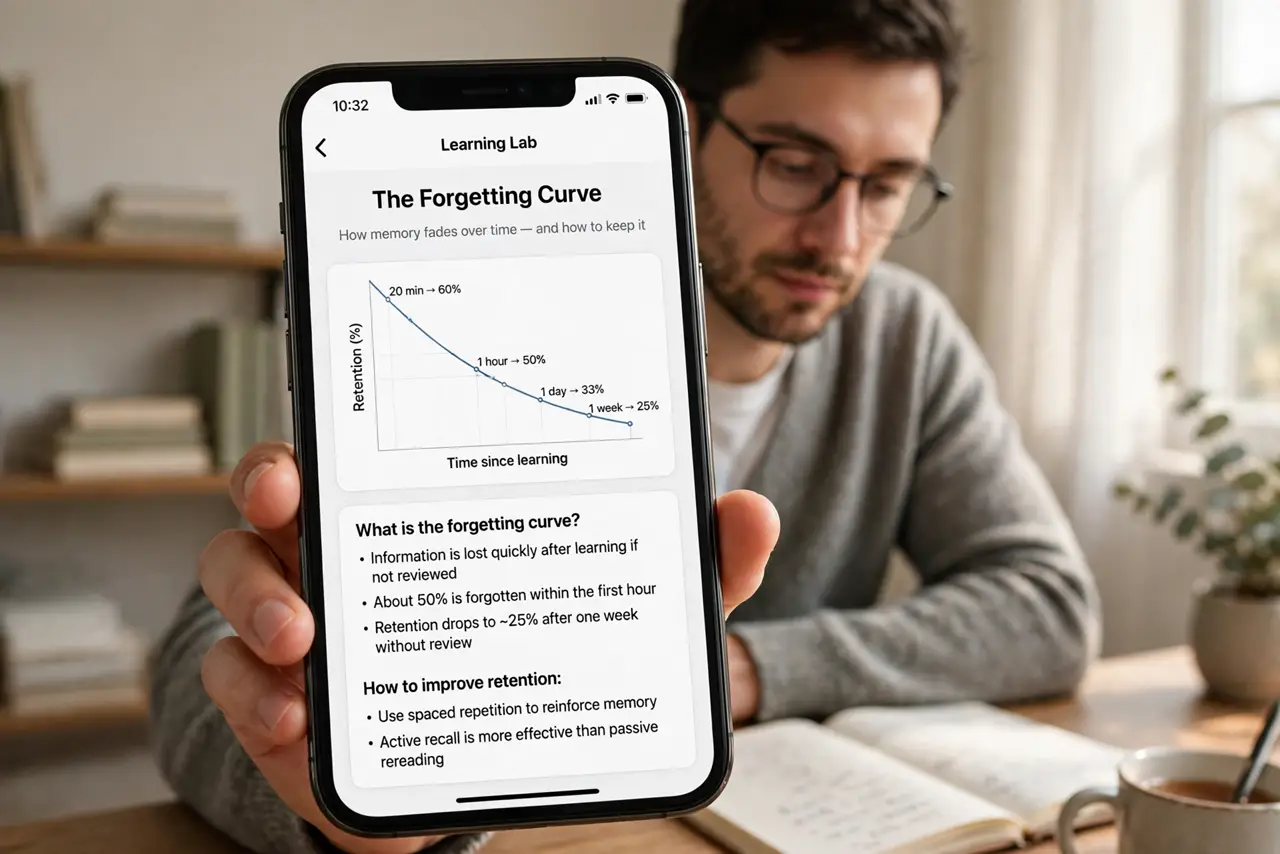
You study for hours, feel confident, and a week later it is gone. That is not a memory problem — it is a scheduling problem. Spaced repetition times your reviews to land just before you would forget, turning the forgetting curve into a staircase. It is the most evidence-backed study method there is, and it runs on flashcards.
TL;DR / Quick Fix
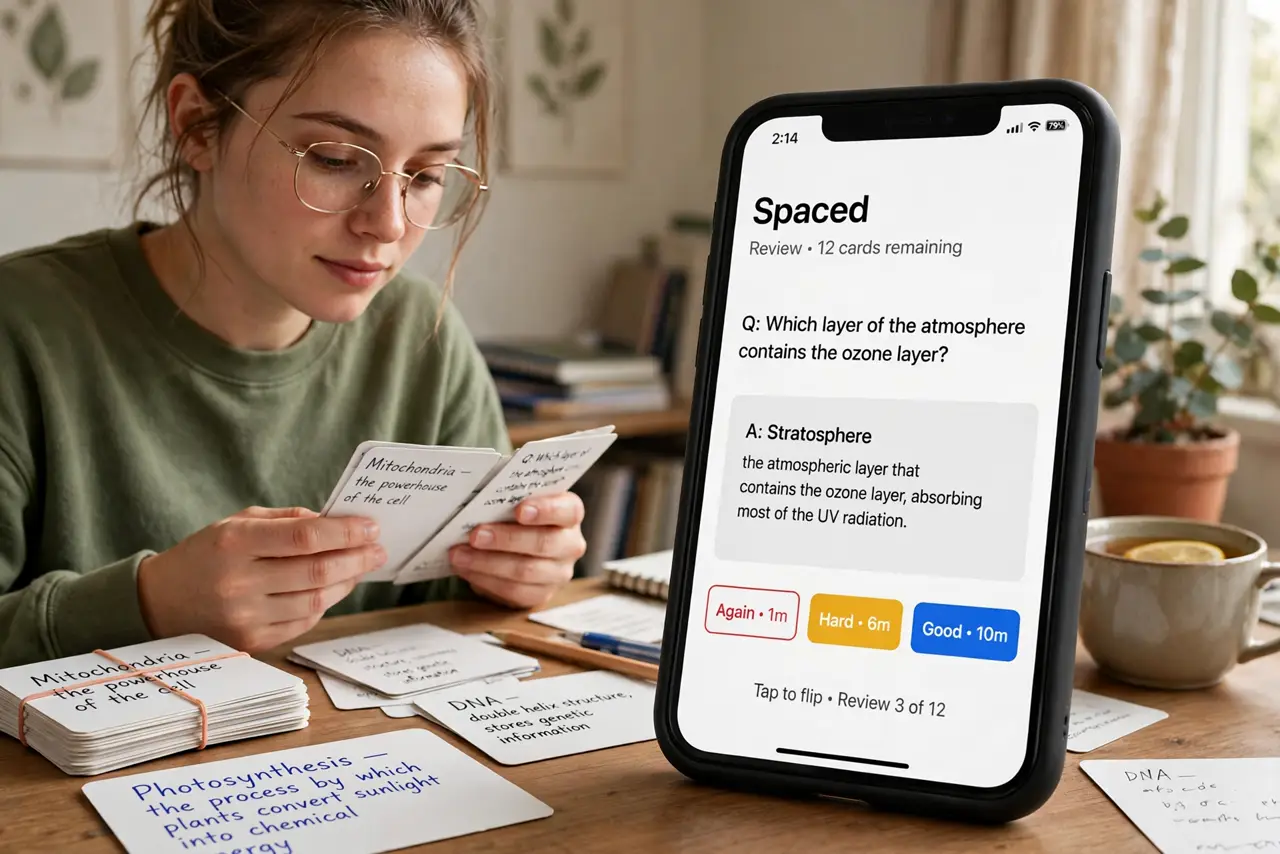
Quick fix: spaced repetition beats cramming — review material at expanding intervals (a day, three days, a week) so each recall lands just before you'd forget. Make simple flashcards with a question on one side, test yourself honestly, and let the app schedule reviews. Twenty minutes daily outperforms weekend marathons.
Follow these steps
- Understand the forgetting curve. New memories decay fast — most of a lesson evaporates within days. Each successful recall resets the decay slower. Spaced repetition schedules reviews at the last useful moment, so every minute of study buys maximum retention.
- Make atomic flashcards. One card, one fact: a question on the front, the answer on the back. 'What causes seasons?' — good. 'Explain astronomy' — not a flashcard, an essay. Atomic cards are gradeable; essays are not.
- Test, do not reread. The learning happens in the retrieval attempt, not in seeing the answer. Cover the back, answer out loud, then check. Rereading feels productive and is nearly worthless — testing feels hard and works.
- Rate honestly. After each card, rate how hard the recall was. Easy cards get pushed far into the future; hard ones come back soon. Honest ratings are the engine — lying to the algorithm just schedules your own forgetting.
- Do short daily sessions. Twenty focused minutes daily beats a five-hour weekend marathon — the science is unambiguous. Daily contact keeps every card near its optimal review moment; marathons let half of them rot.
- Trust the schedule. The app will show you cards that feel 'too easy' or 'already known' — review them anyway. The schedule knows the decay math; your confidence does not. Skipping 'easy' cards is how knowledge silently evaporates.
What NOT to do
- Do not cram the night before. Cramming passes tomorrow's test and fails next month's reality — spaced repetition is for knowledge you want to keep.
- Do not make mega-cards. One card per fact; bloated cards cannot be scheduled or graded, and they rot in the deck.
- Do not skip days casually. The schedule compounds — a missed week means hundreds of overdue cards and the temptation to quit. Protect the streak.
- Do not just collect decks. Downloading 10,000 pre-made cards you never review is procrastination disguised as preparation — make or curate, then actually review.
Frequently asked questions
Which app should I use?
Any true spaced-repetition app with an honest scheduling algorithm — the popular free ones all implement the same core math. Pick the one whose interface you will actually open daily.
Does it work for skills, not just facts?
Yes, with adaptation — break skills into recallable chunks (a chord shape, a verb conjugation). Pure muscle memory still needs practice, but the recall layer benefits enormously.
How long before I see results?
About two weeks of daily sessions. The first week feels slow; then reviews get fast as cards graduate to long intervals — that acceleration is the method working.