Start with Vinyl
Vinyl looks simple — a record spins, music comes out — until you meet the vocabulary: turntables, preamps, cartridges, styluses, and three kinds of inputs. Beginners either overspend on mystique or buy incompatible parts. The reality is kind: a starter setup needs four components, one correct connection order, and a gentle hand with the needle. This guide keeps it to exactly that, plus where speaker placement fits once the music plays.
TL;DR / Quick Fix
Quick fix: starting with vinyl needs just four things — a turntable, a phono preamp (often built in), powered speakers or an amp, and records. Set the turntable level, connect to the phono input, and lower the needle gently. Buy used records first; upgrade the stylus before anything else.
Follow these steps
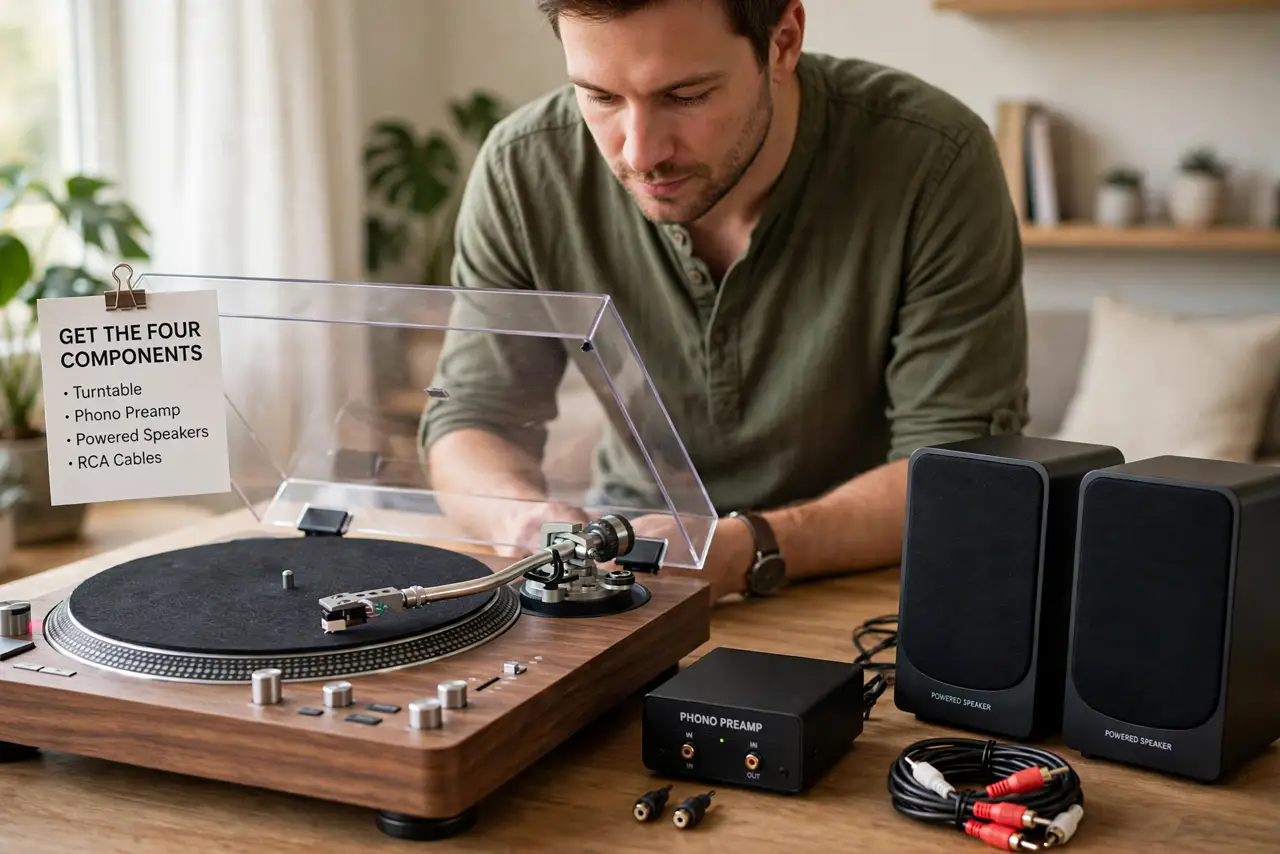
- Get the four components. Turntable, phono preamp (often built into the turntable or speakers — check before buying a separate one), powered speakers or an amplifier with passive speakers, and records. Four things; everything else is optional.
- Set the turntable level and stable. Place it on a solid, level surface away from speaker vibrations. A wobbling or unlevel turntable mistracks — the cheapest upgrade is a stable shelf.
- Connect in the right order. Turntable → phono preamp (or the input labeled PHONO) → speakers/amp. The phono stage must come before any normal line input — see do you need a preamp if the volume is whisper-quiet.
- Handle records by the edges. Fingerprints on the grooves become pops and clicks. Hold by the edge and label, slide in and out of the sleeve carefully — clean hands, clean sound.
- Cue the needle gently. Use the cueing lever to lower the stylus onto the record's edge, never drop it by hand. A gentle landing protects both the stylus and the groove.
- Start with used records. Thrift stores and used bins are full of cheap records for learning. Practice handling, cleaning, and cueing on two-dollar finds before playing anything precious.
What NOT to do
- Do not buy an expensive turntable first. A decent entry deck teaches you everything — upgrade when you can hear its limits, not before.
- Do not play records on a wobbly table. Vibration and tilt cause mistracking that wears records — stability first, always.
- Do not touch the playing surface. Oils from fingers attract dust and become permanent noise — edges and label only.
- Do not stack records flat in piles. Store them upright like books — flat stacking warps vinyl over time.
Frequently asked questions
How much does a starter setup cost?
A sensible entry setup — decent turntable with built-in preamp plus powered speakers — costs about as much as a mid-range pair of headphones. Records themselves can be nearly free secondhand.
Do I need to clean records?
Yes, eventually: a carbon-fiber brush before each play handles daily dust. Wet cleaning is for thrift-store rescues, not every record.
Is vinyl actually better sounding?
Different, not objectively better — the ritual, the artwork, and the focused listening are the real upgrade. Anyone promising sonic miracles is selling something.