Teach What You Learn
You can follow a tutorial perfectly and still freeze when asked to explain it — because following is not understanding. Teaching forces the difference into the open: the moment you try to put an idea in plain words, every gap in your knowledge announces itself. Explaining what you learn is the fastest way to find out what you do not actually know.

TL;DR / Quick Fix
Quick fix: after learning something, explain it out loud in simple words as if to a beginner — no jargon allowed. Every place you stumble is a gap to restudy. Write the explanation down; that note becomes your best review material later.
Follow these steps
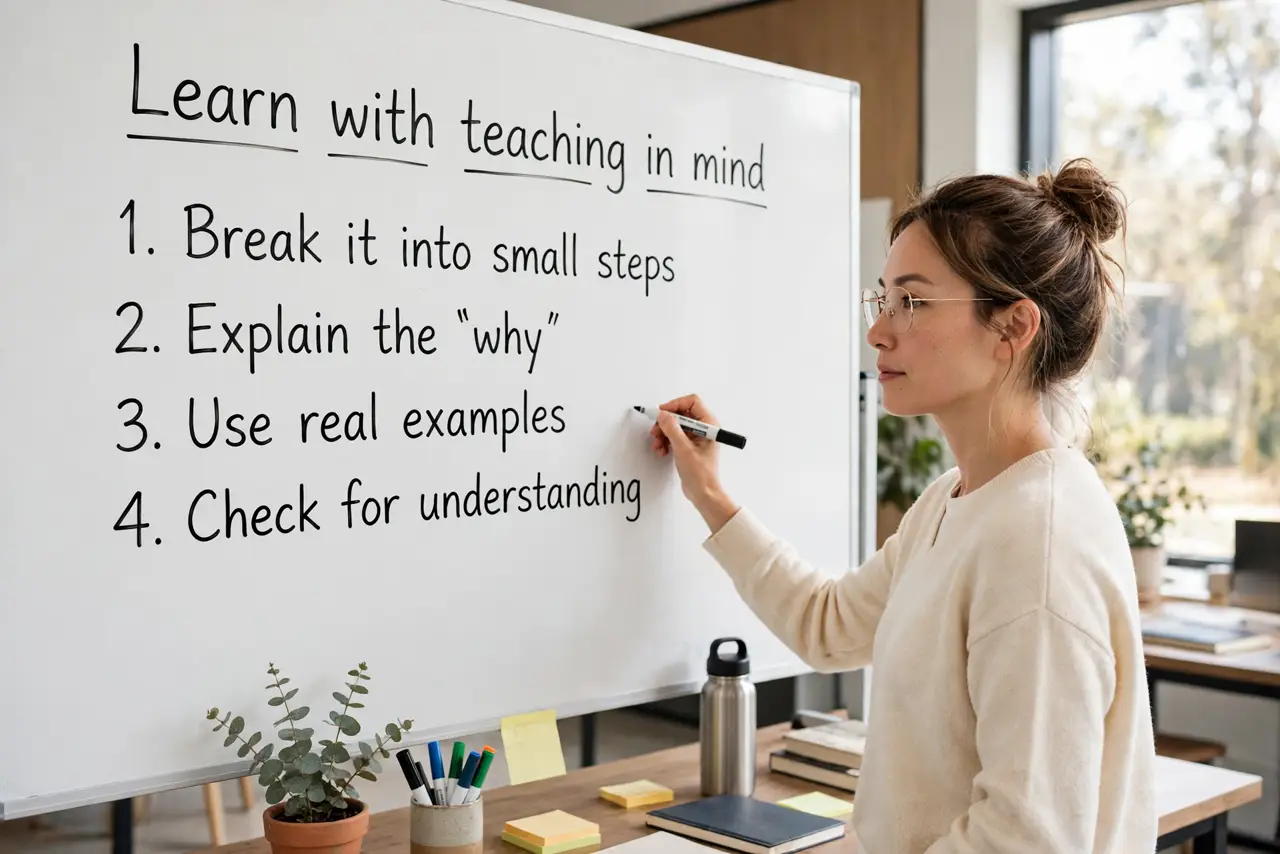
- Learn with teaching in mind. As you study, notice what would be hard to explain — those are the fragile parts. The intention to teach changes how you read: actively, skeptically, completely.
- Explain it out loud simply. Close the material and teach an imaginary beginner. Plain words only — jargon is often a hiding place for shallow understanding. Record it on your phone if that helps.
- Find every stumble. Each hesitation, hand-wave, or let me skip this part marks a gap. Write the stumbles down — that list is your personalized study plan, better than any premade one.
- Restudy only the gaps. Go back to the material for the stumbled parts only. Re-explaining after patching them is the recall loop at its most powerful.
- Write the final explanation. Turn your smooth explanation into a short note or post. Writing forces completeness — speech lets gaps slide, text does not.
- Teach a real person when you can. Questions from a real learner expose gaps your solo practice missed. A confused face is the most honest feedback your understanding will ever get.
What NOT to do
- Do not teach from the book open. Reading aloud is presenting, not teaching — the book must be closed for the gaps to show.
- Do not hide behind jargon. If the explanation needs technical terms to sound right, the understanding is not there yet.
- Do not skip the stumbles. Hand-waving past the hard part is exactly how shallow knowledge survives undetected.
- Do not wait until you feel ready. Teaching while learning is the method — mastery first defeats the purpose.
Frequently asked questions
Do I need an audience?
No — an imaginary student works. The explaining does the work, not the listening. A real audience just adds better questions.
What if I teach something wrong?
Then you have found a gap with an audience — even better. Corrections after teaching stick harder than corrections before.
How is this different from summarizing?
Summaries compress the material; teaching reconstructs it for someone else. Reconstruction is the harder, more revealing act.