Capture Everything, Decide Later
Ideas vanish. You think of the perfect birthday gift in the shower, a work task while driving, a brilliant sentence at 2 AM — and by morning they are gone. The GTD capture habit fixes this with one rule: write everything down the instant it appears, into one inbox you trust. Your brain stops nagging you about things it believes are safely caught. This guide builds the habit.
TL;DR / Quick Fix
Quick fix: the GTD capture habit is simple — write down every task, idea, and commitment the moment it appears, in one inbox you trust. Your brain stops nagging once it believes the system caught it. Review the inbox daily; capturing without reviewing just loses things more neatly.
Follow these steps
- Pick one inbox. One notes app, one notebook, one voice-memo shortcut — a single default place everything goes. Multiple inboxes mean ideas scattered across five apps, which is barely better than your head. The GTD basics start here for a reason.
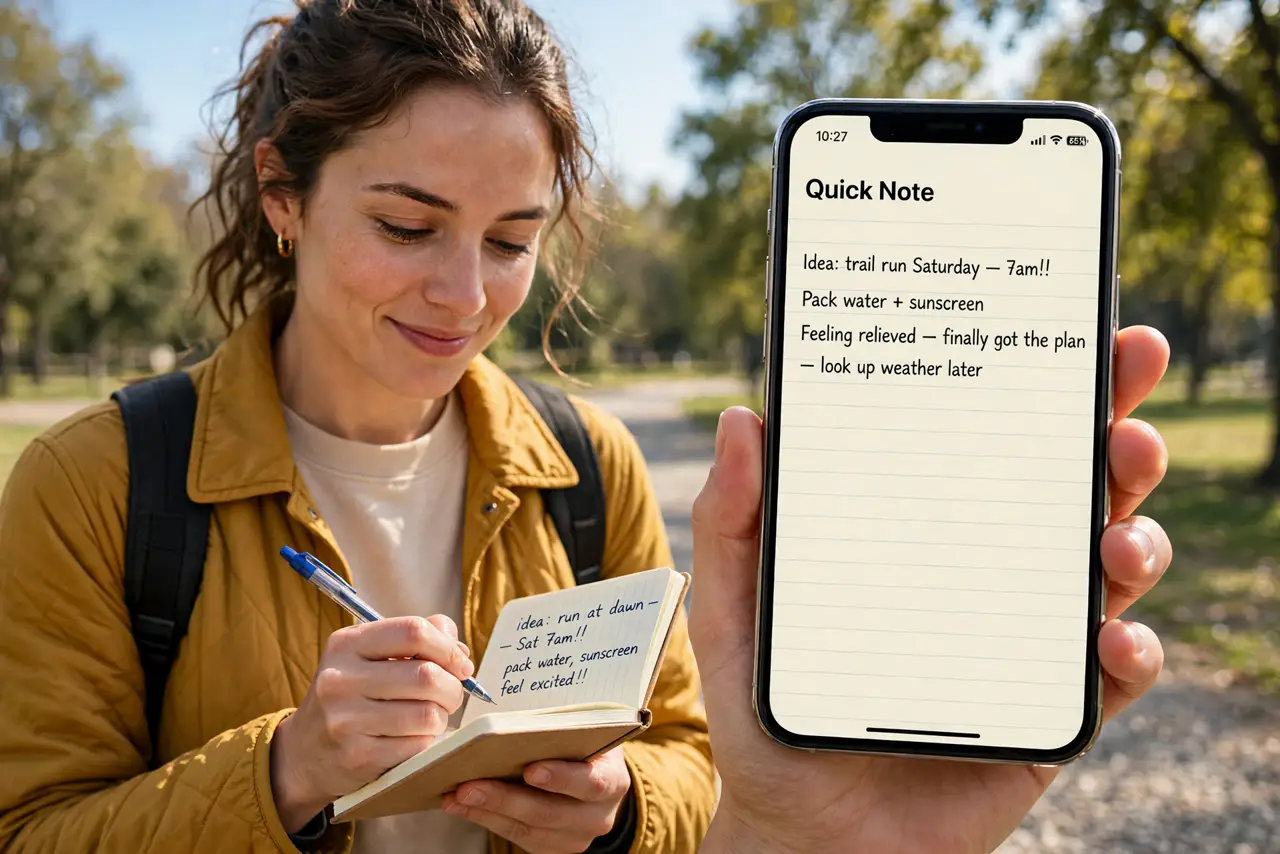
- Capture the instant it appears. The rule is immediacy: the thought gets written down within seconds, in whatever shorthand works. 'Call dentist re: crown' beats a perfect sentence you never write — capture now, clarify later.
- Make capture frictionless. Put the capture tool one tap away: a home-screen widget, a watch complication, a notebook in your pocket. Every extra step loses ideas — if capturing takes ten seconds, you will do it; if it takes a minute, you will not.
- Capture everything, not just tasks. Ideas, worries, 'maybe someday' dreams, things to look up — all of it. The brain nags about open loops of every kind; selective capturing leaves the nagging running.
- Empty the inbox daily. Capture is only half the system. Once a day, process the inbox: delete, do, delegate, or file each item into its proper list. An inbox you never empty becomes a second junk drawer.
- Trust it completely. The magic only works when you genuinely believe nothing falls through. That trust is earned by weeks of consistent capture-and-process — after that, the mental background chatter genuinely quiets down.

What NOT to do
- Do not use five different capture tools. Scattered inboxes recreate the original problem — one inbox, no exceptions.
- Do not capture without processing. An inbox you never empty is a write-only graveyard; the daily processing is what makes capture trustworthy.
- Do not write essays in the inbox. Capture is triage, not doing — a fragment is enough; elaboration happens during processing.
- Do not keep it all in your head 'because it is small.' Small things are exactly what slip — the habit works because it is total, not selective.
Frequently asked questions
Paper or app for capture?
Whichever you will actually use in the moment. Paper is fastest for many; an app syncs everywhere. The best inbox is the one within arm's reach when the idea strikes.
What counts as an inbox?
Any single place unprocessed stuff lands: a notes app inbox, a physical tray, a voice memo folder. The defining trait is that you process it regularly, not where it lives.
I capture but never process. Help?
Shrink the processing to five minutes daily at a fixed time — even incomplete processing beats none. The habit compounds; perfection is not required.