Open vs Closed Headphones?
Two headphones look identical, but one leaks your music to the whole office while the other traps heat around your ears. Open-back and closed-back is the fundamental headphone fork: open trades isolation for a natural soundstage; closed trades soundstage for privacy. Pick wrong and you will annoy everyone — or miss the music's magic.

TL;DR / Quick Fix
Quick fix: closed-back headphones seal sound in and noise out — best for offices, commuting, and recording. Open-back headphones sound more natural and spacious but leak sound both ways — best for quiet home listening. For shared spaces, closed wins. For solo critical listening, open wins.
Follow these steps
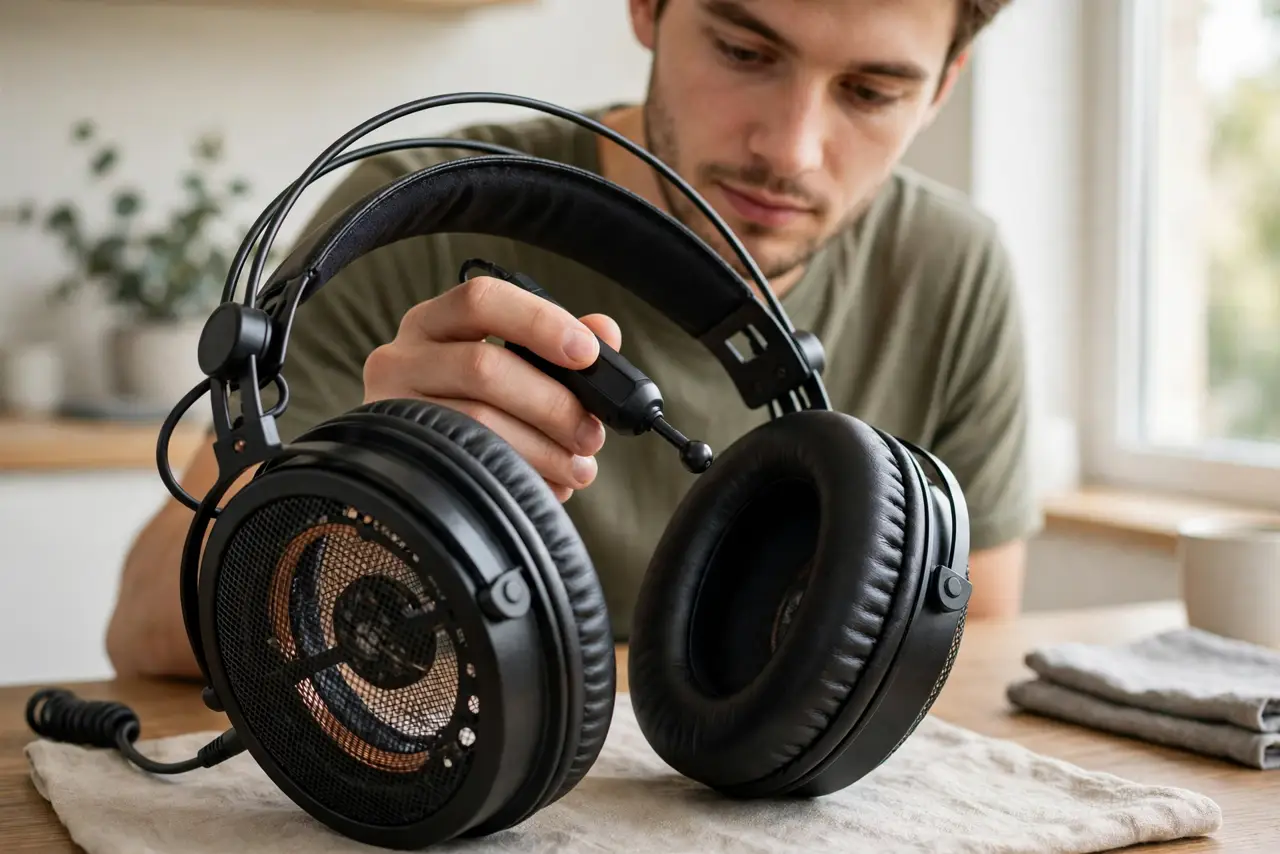
- Understand the physical difference. Closed backs seal the earcup; open backs have vents or mesh. That single design choice decides isolation, leakage, and much of the sound character.
- Match to your environment. Office, commute, library, recording: closed. Quiet room at home: open. The room decides more than your taste does.
- Know the sound trade-off. Open backs typically sound wider and more natural; good closed backs sound intimate and punchy. Neither is objectively better — they are different presentations.
- Consider noise cancelling separately. ANC is a different feature that lives almost entirely on closed backs — see noise cancelling for how it works. Do not confuse the two decisions.
- Mind heat and comfort. Closed backs trap warmth — long sessions get sweaty. Open backs breathe. In hot climates this matters daily.
- Test leakage honestly. Play your normal volume and have someone sit three feet away. If they hear your music, that is your answer for shared spaces.
What NOT to do
- Do not wear open backs in an office. Your coworkers will hear every hi-hat — and they will tell you.
- Do not record vocals with open backs. The backing track leaks into the microphone.
- Do not assume pricier open backs are 'better' for commuting. The wrong design at any price is the wrong design.
- Do not forget Bluetooth delay if you watch video wirelessly — the back design does not affect latency, but the wireless link does.
Frequently asked questions
Can others hear my open-back headphones?
Yes — clearly, at normal volumes. That is the defining trade-off, not a defect.
Which is better for gaming?
Closed for competitive play — isolation and positional focus. Open for immersive single-player — wider soundstage.
Do open backs need an amplifier?
Many do — open-back designs often pair with higher-impedance drivers. Check the specs; a phone may not drive them well.