Pick a Note-Taking Method
You take pages of notes — in class, in meetings, from books — and never look at them again, because rereading them feels like wading through mud. The problem is rarely effort; it is method. Notes captured as flat transcripts are hard to review and harder to use. A real method gives your notes structure at capture time, so reviewing them later is fast and actually useful.

TL;DR / Quick Fix
Quick fix: notes fail when they are just transcripts — pick one method and stick with it: Cornell for classes, Zettelkasten for connecting ideas, or PARA for projects. Review within 24 hours and rewrite highlights in your own words. A method you use beats the perfect one.
Follow these steps
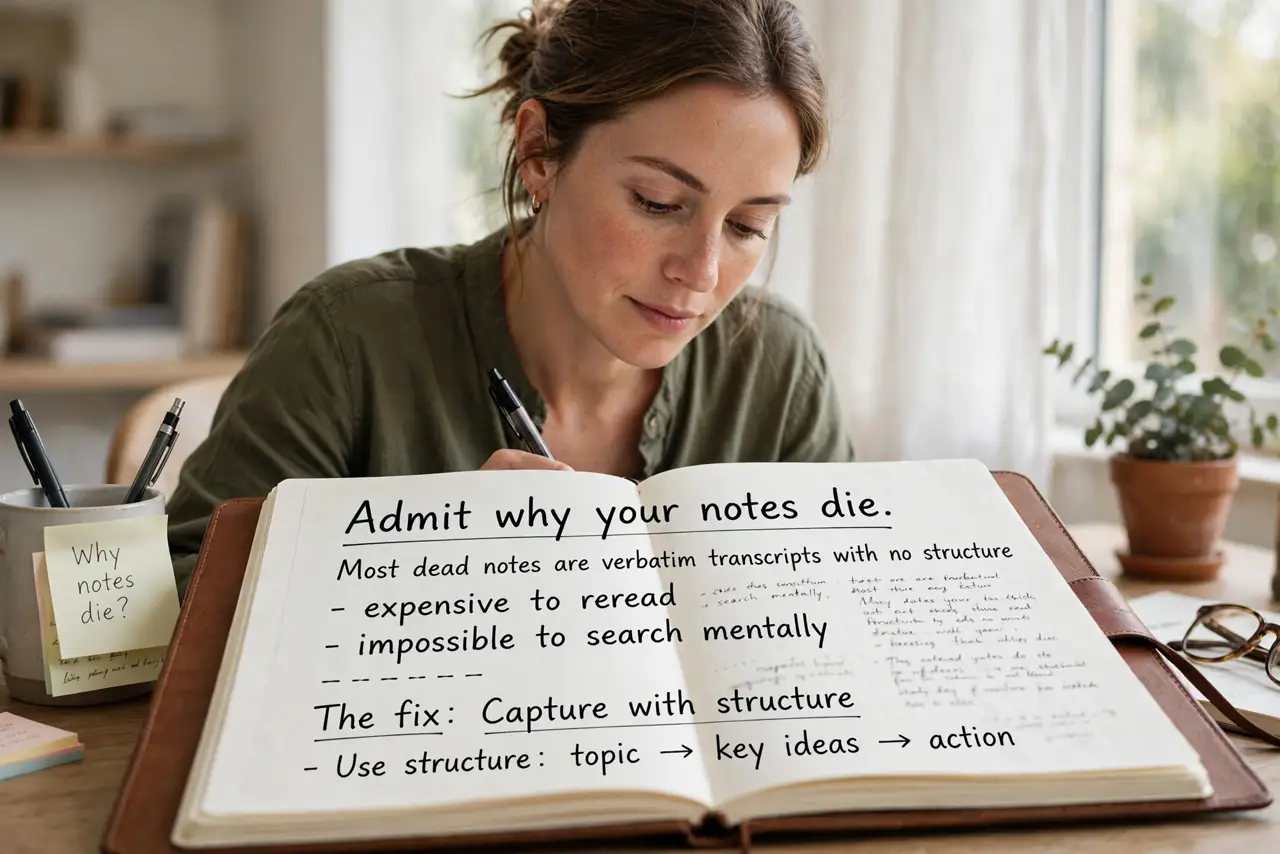
- Admit why your notes die. Most dead notes are verbatim transcripts with no structure — expensive to reread, impossible to search mentally. The fix is capturing with a shape that makes review easy, not capturing more words.
- Try Cornell for classes and meetings. Split the page into notes, cues, and summary. Details go on the right during the session; questions and keywords on the left afterward. The full walkthrough is in Try Cornell Notes — it is the fastest method to learn.
- Try Zettelkasten for ideas that connect. Write one idea per note, in your own words, and link notes to each other as relationships appear. Slow to start, powerful over years — see What Is Zettelkasten? for the plain version.
- Try PARA for projects and life admin. Sort everything into Projects, Areas, Resources, Archives. It organizes by actionability instead of topic — the PARA method guide covers the setup in plain steps.
- Review within 24 hours. Whatever method you pick, the review is where learning happens: reread, highlight, and rewrite the key points in your own words. Notes reviewed once beat notes captured perfectly and never reopened.
- Commit to one method for two weeks. Method-hopping is the real killer. Pick the one that fits your main use, use it exclusively for two weeks, then judge — and make survivors notes that last so the effort compounds.
What NOT to do
- Do not collect methods instead of using one. Reading about five systems is procrastination wearing a productivity costume.
- Do not transcribe everything verbatim. Capturing every word guarantees you will never review any of them — capture the structure, not the stream.
- Do not skip the review. Unreviewed notes are just a diary of things you once heard; the 24-hour review is the whole point.
- Do not spread notes across five apps. One capture tool, one method — fragmentation kills retrieval faster than any bad method.
Frequently asked questions
Paper or digital — which is better?
Whichever you will actually review. Paper wins for memory in studies; digital wins for search. The method matters more than the medium.
What is the best notes app?
The one you already open daily. Fancy features never saved a note that was never reviewed — pick boring and reliable.
How long should I keep old notes?
Keep summaries and linked notes; archive raw captures. If a note has no summary and no links after a month, it was never going to be useful.