OLED vs QLED?
TV shopping throws two acronyms at you — OLED and QLED — and the price tags differ by a thousand dollars. They are fundamentally different technologies: OLED pixels make their own light, QLED is an LCD with a fancy backlight. The right choice depends on your room, your habits, and your budget — not the showroom demo.
TL;DR / Quick Fix
Quick fix: choose OLED for dark-room movie watching — perfect blacks, unbeatable contrast. Choose QLED (or Mini-LED) for bright rooms — much brighter, no burn-in risk, cheaper. Gamers with static HUDs should lean QLED; film lovers in dark rooms should lean OLED. Room brightness decides more than brand.
Follow these steps
- Learn what OLED actually is. Each OLED pixel produces its own light and turns fully off for black. The result: perfect blacks and infinite contrast — the burn-in reality is the tradeoff to understand, not fear.
- Learn what QLED actually is. QLED is an LCD panel with quantum-dot color and LED backlighting — brighter than OLED, cheaper, immune to burn-in. Blacks are good, not perfect.
- Match the TV to your room. Bright living room with big windows? QLEDs brightness wins daily. Dedicated dark movie room? OLEDs blacks are transformative. Room first, technology second.
- Consider your viewing habits. News tickers, sports scores, game HUDs parked for hours — static elements favor QLED. Varied movies and shows favor OLED — the burn-in prevention habits cover the cautious.
- Know the Mini-LED middle ground. Mini-LED is a supercharged QLED-style backlight — near-OLED blacks, QLED brightness. The Mini-LED explainer details the option splitting the difference.
- Compare the real TV, not the acronym. A great QLED beats a cheap OLED and vice versa. The TV comparison pits specific models — panel quality within each camp varies enormously.

What NOT to do
- Do not buy OLED for a sun-drenched room. Brightness matters more than blacks when fighting daylight — QLED wins there.
- Do not buy QLED expecting OLED blacks. Blooming around bright objects is the known tradeoff — physics, not defects.
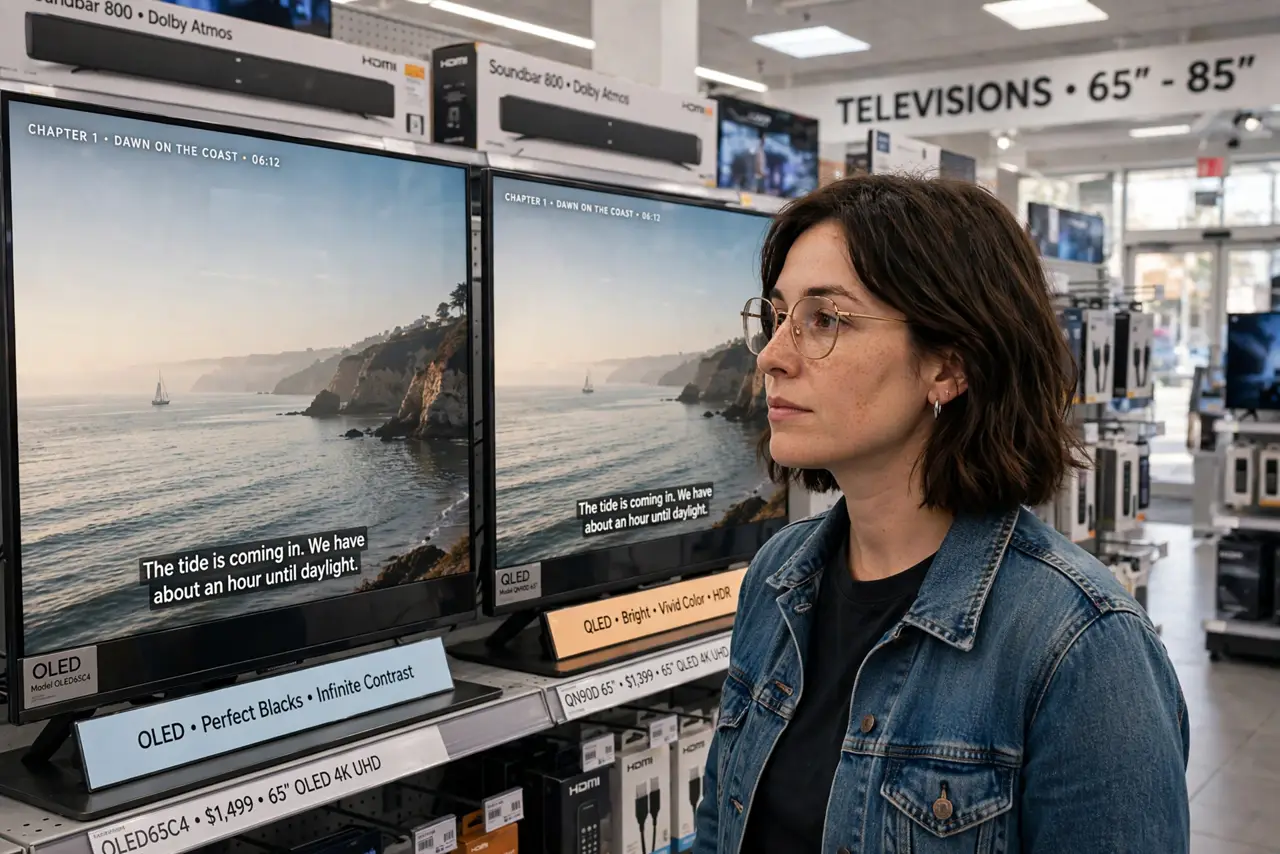
- Do not judge in the store alone. Showroom torch mode flatters everything; your living room is the real test.
- Do not pay for features you will not use. 8K, 144Hz gaming modes — match the TV to your actual content.
Frequently asked questions
Is OLED worth the premium?
For dark-room film watching, yes — the contrast is visibly superior. For bright mixed use, the premium buys less visible benefit.
Does QLED have burn-in?
No — it is LCD-based, so static images cannot burn in. That is its biggest practical edge over OLED.
What about Mini-LED versus both?
The sensible middle: better blacks than QLED, brighter and safer than OLED. Many buyers land here.