Passphrase vs Password? Which Wins
Security advice keeps saying to use a passphrase instead of a password, but the difference sounds like wordplay. A passphrase is just a password made of several ordinary words, and it is both stronger and easier to remember. This guide shows why it wins.
TL;DR / Quick Fix
Quick fix: build passwords from four or more random ordinary words, like a short sentence only you would pick. They are harder to guess than short tricky passwords and far easier to remember. Use a unique passphrase for each important account, and let a password manager handle the rest.
Follow these steps
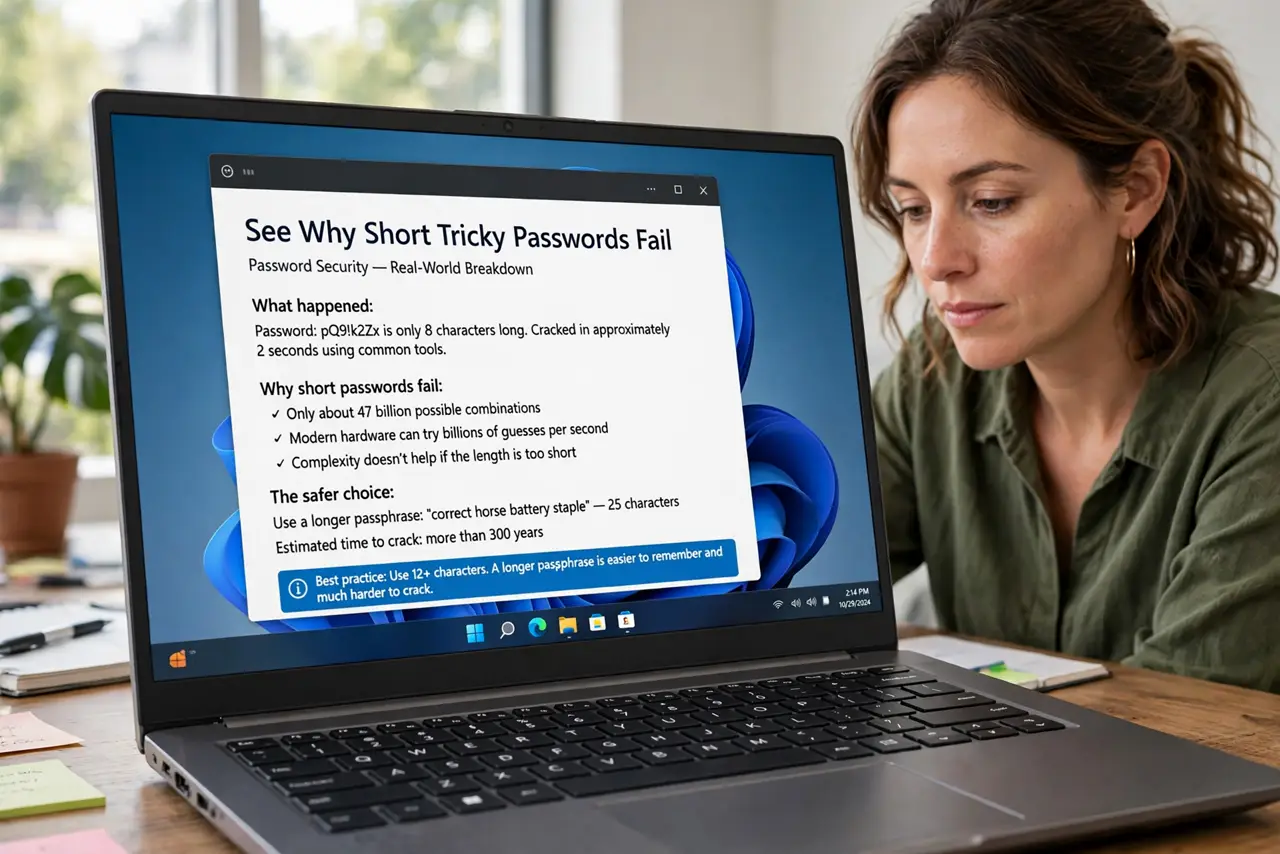
- See why short tricky passwords fail. A password like Tr7!x2 is hard for you to remember but short enough for computers to grind through. Length beats complexity, and humans are bad at both remembering and typing complexity.
- Build a passphrase from random words. Pick four or more unrelated ordinary words, like correct horse battery staple. Randomness matters — a famous quote or song lyric is guessable.
- Make it yours but keep it random. You can add a number or swap a word to meet a site's rules, but keep the words themselves random. Do not use your pet's name plus your birth year.
- Use one passphrase per important account. A great passphrase reused everywhere has the same weakness as any reused password. Uniqueness matters as much as strength.
- Let a manager handle the boring accounts. You only need to memorize a few passphrases — for your manager and main email. A password manager stores the rest.
- Test that you can type it reliably. Type the new passphrase a few times over two days. If you keep mistyping it, swap one word rather than shortening the whole thing.
What NOT to do
- Do not use song lyrics or quotes. Attackers try published phrases first, so 'random' must mean actually random words.
- Do not shorten it to two words to make it easy. Two ordinary words fall fast; four or more is where the strength lives.
- Do not share your passphrase pattern with anyone. If someone knows you always use four words plus a year, your accounts get much easier to guess.
- Do not reuse the same passphrase on every site. Strength without uniqueness still loses to a single breach.
Frequently asked questions
How many words make a strong passphrase?
Four random words is a solid minimum, five or six is better. Each added word multiplies the guessing effort enormously.
Are passphrases better than passkeys?
Passkeys win where available since they cannot be phished. But passphrases are still the best password-style option, and you will need passwords for years to come.
What if a site limits password length?
Some old sites cap at 12 or 16 characters. Use the longest passphrase the site allows, and make sure it is unique to that site.