Pick a Power Bank
Power banks promise 50,000mAh for $15 — and deliver a fraction of that before dying in three months. The market is flooded with inflated specs and no-name cells, but picking a good one is simple once you know the three numbers that matter: capacity, output wattage, and honesty. Here's the filter.
TL;DR / Quick Fix
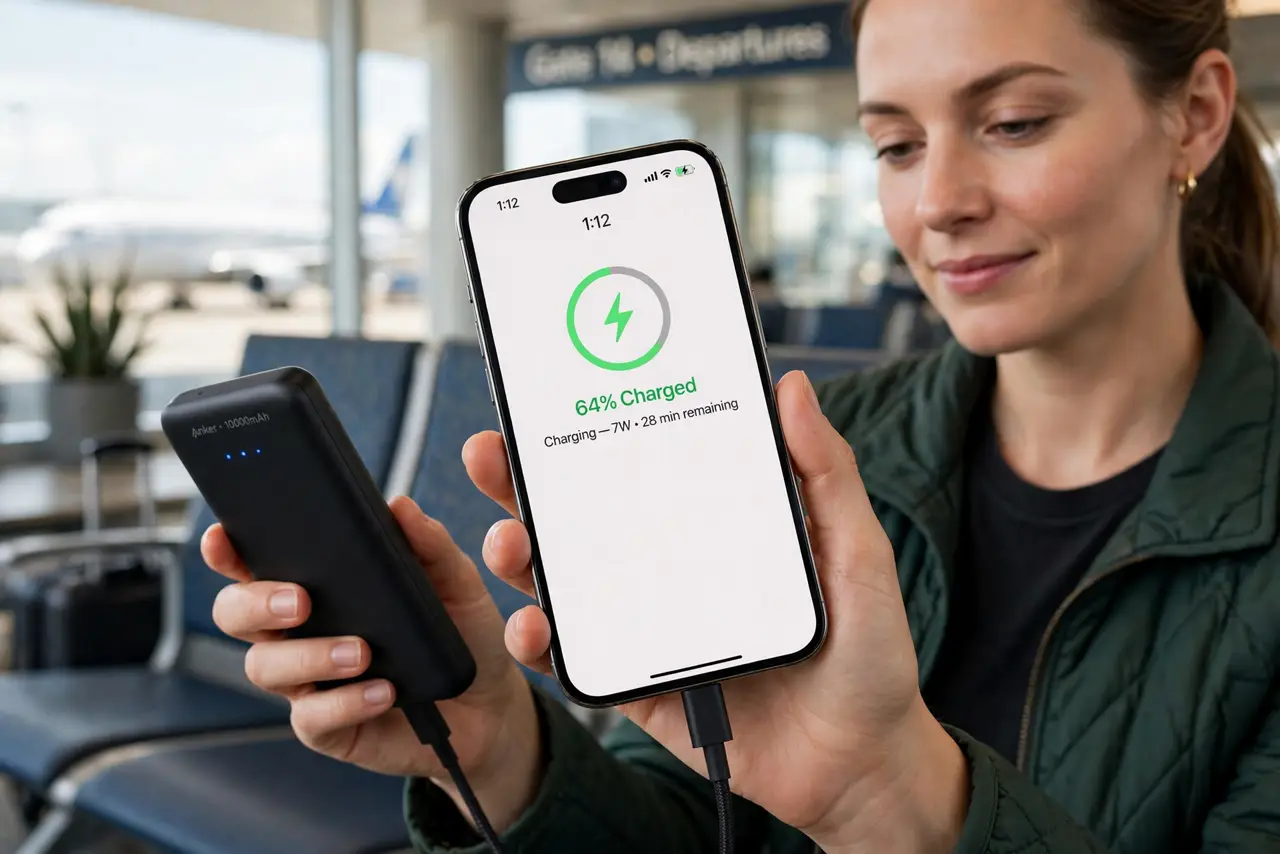
Quick fix: match capacity to your phone — 10,000mAh charges most phones two to three times. Check output wattage for fast charging, and buy from known brands; inflated capacity claims are rampant. For laptops, you need 20,000mAh+ with USB-C PD.
Follow these steps
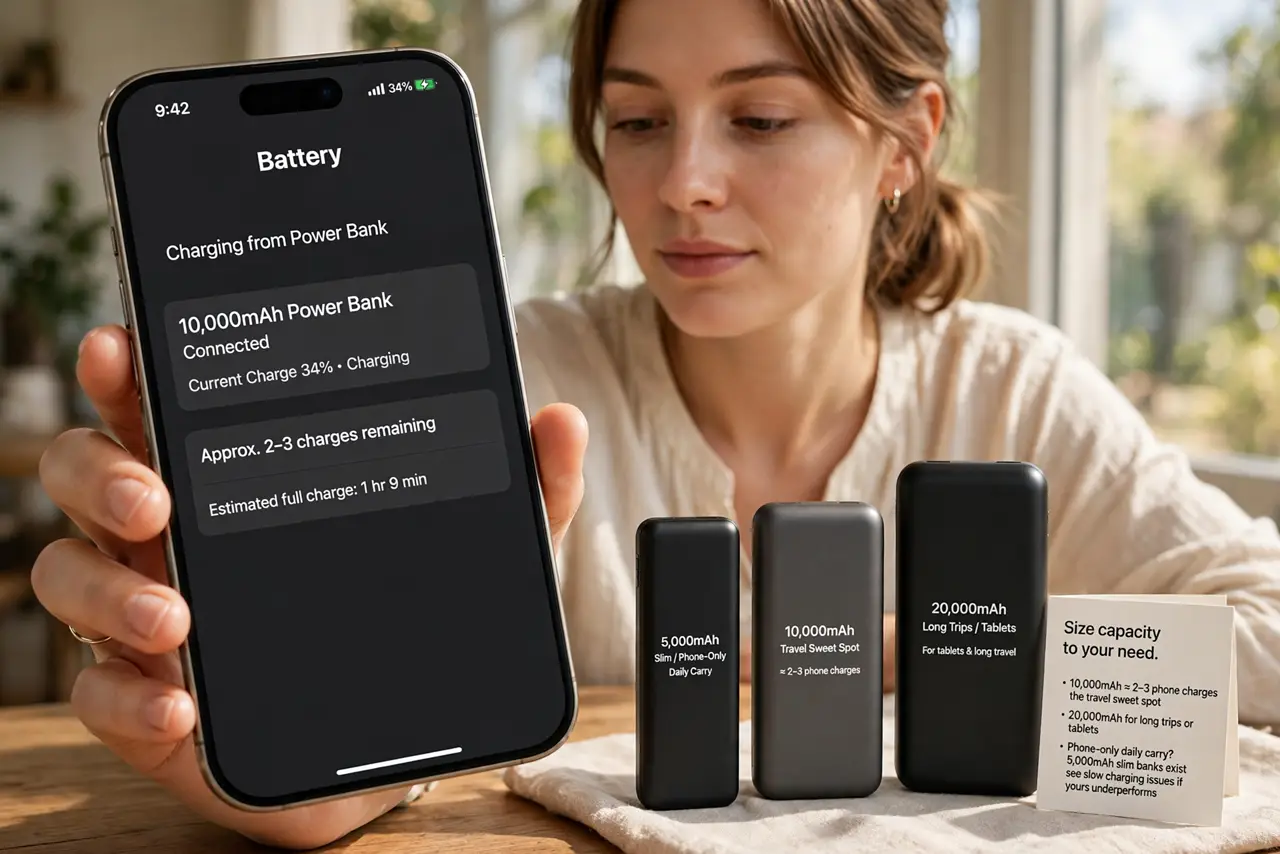
- Size capacity to your need. 10,000mAh ≈ 2-3 phone charges — the travel sweet spot. 20,000mAh for long trips or tablets. Phone-only daily carry? 5,000mAh slim banks exist — see slow charging issues if yours underperforms.
- Check output wattage, not just capacity. 18W+ for decent phone fast-charging; 45-65W USB-C PD for laptops. A huge capacity with 10W output charges painfully slowly — see laptop charging failures.
- Buy known brands only. Anker, and other established makers with real warranties. The $12 '50,000mAh' listing is lying about capacity and skimping on safety circuitry — both matter.
- Verify the real capacity. Rated capacity is at the internal cell voltage; delivered capacity is ~60-70% of the label. Honest brands state both; dishonest ones trumpet the bigger number.
- Mind airline limits. Most airlines cap spare batteries at 100Wh without approval (roughly 27,000mAh). Check before flying with a monster bank — confiscation at security is real.
- Maintain it lightly. Recharge every few months even unused; store around half-full for long idle periods. Lithium cells degrade fastest at full charge in heat.
What NOT to do
- Do not buy absurd-capacity no-name banks. The specs are fiction and the cells can be unsafe — cheap lithium with no protection circuitry is a fire risk.
- Do not judge by capacity alone. A 20,000mAh bank with 10W output is worse for daily use than a 10,000mAh bank with 22W — wattage is usability.
- Do not leave it baking in a car. Heat kills lithium cells fast; a power bank on a summer dashboard ages years in an afternoon.
- Do not fly with it in checked luggage. Spare lithium batteries belong in carry-on, always — it's the rule on virtually every airline.
Frequently asked questions
How many charges will 10,000mAh give?
About two to three full phone charges, accounting for conversion losses. Rated capacity never fully reaches your phone.
Can a power bank charge a laptop?
Yes if it has USB-C PD at sufficient wattage (45W+ for most laptops) — see when it will not for the failure modes.
Why does my power bank charge so slowly?
Usually low output wattage, a weak cable, or the phone's own charging limits — see the slow-charge checklist.