Pick Filament (PLA vs PETG)
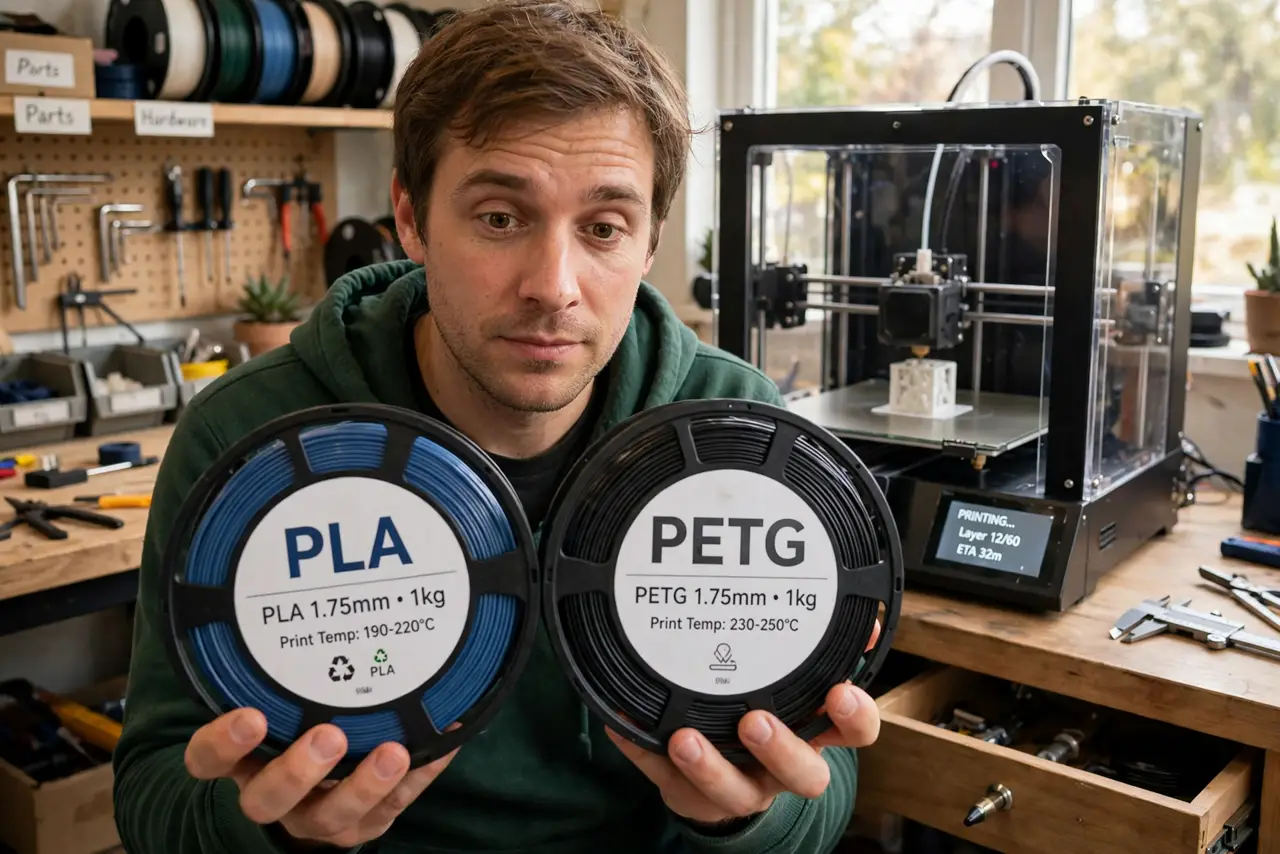
You are staring at filament spools — PLA, PETG, ABS, TPU — with no idea which one your print needs. Pick wrong and the print warps, snaps, or smells up the house. PLA and PETG cover nearly every beginner project; the rest are specialists. Here is the plain-English picker.
TL;DR / Quick Fix
Quick fix: start with PLA — it prints easily, smells mild, and suits decorative prints and prototypes. Choose PETG for strength, heat resistance, or outdoor durability; it prints nearly as easily. Avoid ABS as a beginner: it warps and needs ventilation. Match the filament to the job, not the hype.
Follow these steps
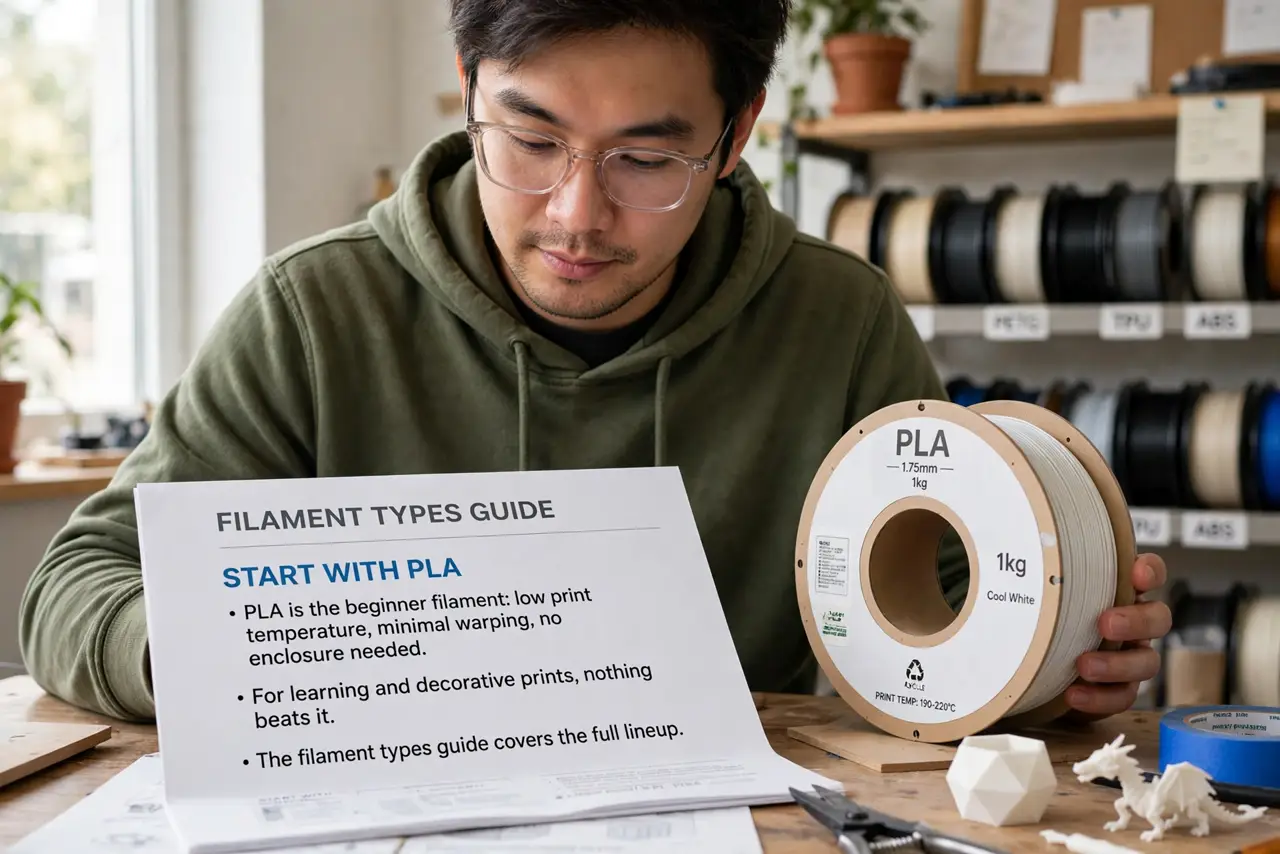
- Start with PLA. PLA is the beginner filament: low print temperature, minimal warping, no enclosure needed. For learning and decorative prints, nothing beats it. The filament types guide covers the full lineup.
- Choose PETG for functional parts. PETG is stronger, more heat-resistant, and survives outdoors. Brackets, hooks, and car parts want PETG; desk toys are happy with PLA.
- Avoid ABS until you have ventilation. ABS is strong but warps badly and fumes while printing. It needs an enclosure and airflow — a second-filament project, not a first.
- Store filament dry. Filament absorbs moisture and prints badly when wet — popping sounds and rough surfaces are the symptoms. Keep spools sealed with desiccant.
- Match nozzle temperature to the spool. Every spool lists its temperature range. Print too cold and layers delaminate; too hot and you get stringing. Start mid-range and tune.
- Slice for the material. Your slicer settings must match the filament: temperatures, speeds, and cooling differ per material. Wrong profile, failed print.
What NOT to do
- Do not buy five materials as a beginner. One spool of PLA teaches you more than a shelf of exotic filaments.
- Do not print ABS in a bedroom. The fumes need ventilation — treat it like a workshop material, not a desk toy.
- Do not ignore wet filament symptoms. Popping, stringing, and rough layers usually mean moisture, not a broken printer.
- Do not assume stronger is always better. PETG's strength is wasted on a decorative vase — and it strings more than PLA.
Frequently asked questions
PLA or PETG for outdoor use?
PETG. PLA softens in heat and degrades in sun; PETG handles both far better.
What is TPU for?
Flexible prints — phone cases, gaskets, vibration dampers. It prints slowly and needs direct-drive extruders ideally.
Can I mix brands of PLA?
Yes, but recalibrate temperatures per spool. Even two PLAs can want different settings.