Smart Rings Explained
A smart ring looks like ordinary jewelry and quietly tracks your sleep, activity, and heart rate around the clock. No screen, no buzzing, no charging every night — that is the appeal. But a ring cannot do what a watch does, and the subscription fees surprise a lot of buyers. Here is what the category actually offers.
TL;DR / Quick Fix
Quick fix: smart rings are best at sleep and recovery tracking — comfortable overnight, unlike most watches. They track heart rate, activity, and readiness scores but have no screen, GPS, or notifications. Check whether the app needs a paid subscription: the ring price is rarely the whole price.
Follow these steps
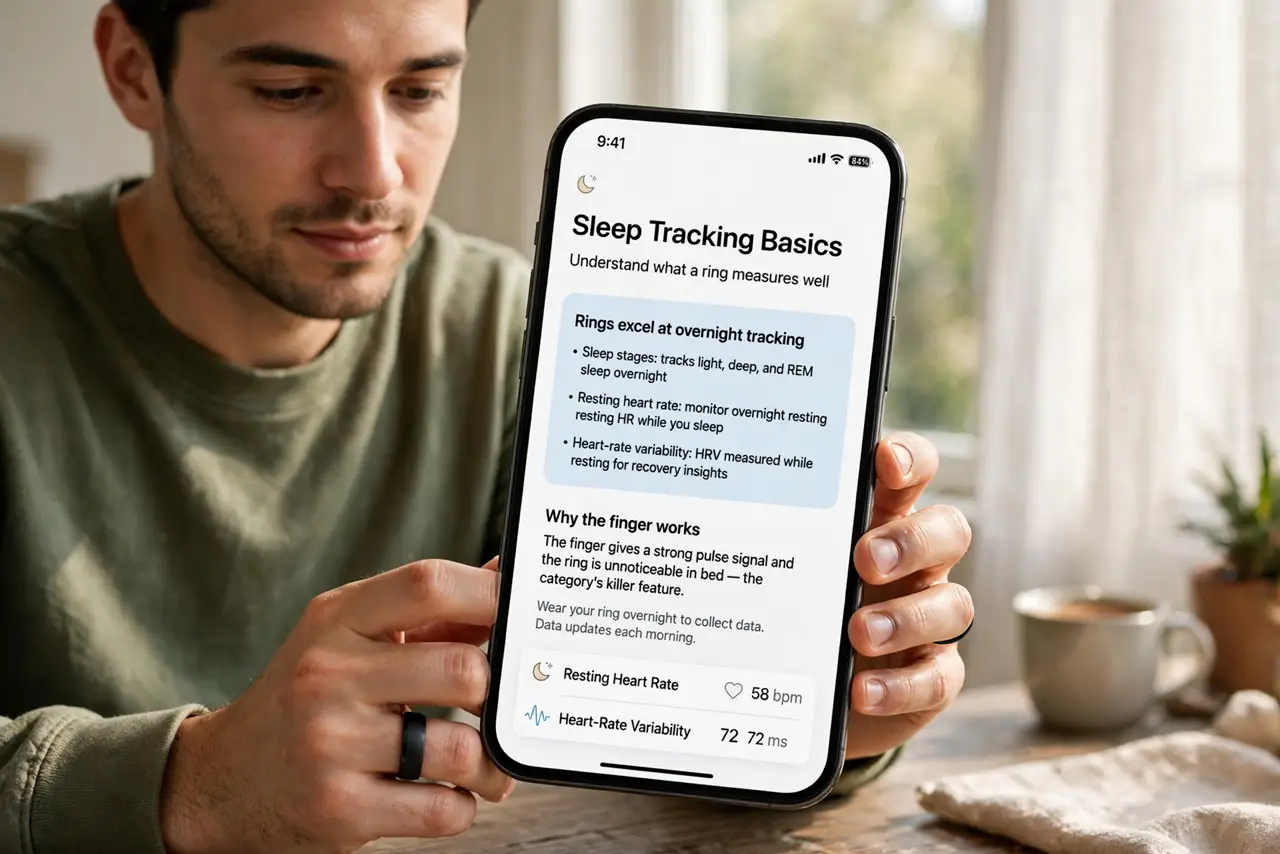
- Understand what a ring measures well. Rings excel at overnight tracking: sleep stages, resting heart rate, and heart-rate variability. The finger gives a strong pulse signal and the ring is unnoticeable in bed — that is the category’s killer feature. See sleep tracking basics for what the data actually means.
- Know what it cannot do. No screen means no notifications, no time display, no on-device controls. Most rings lack GPS, so workouts need your phone along for route tracking. If you want glanceable info, you want a watch instead.
- Check the subscription question. Several major rings require a monthly subscription to see your full data — the ring alone shows almost nothing. Add up a year or two of fees before comparing prices; a ‘cheaper’ ring with a subscription often costs more.
- Get the sizing right. Ring makers send a sizing kit first — wear the sizer for a full day, since fingers swell and shrink. A ring that is perfect at noon can be painfully tight after a workout or loose in cold weather.
- Set expectations for accuracy. Rings are good at trends — sleep patterns, recovery direction — and weaker at moment-to-moment precision like sprint heart-rate spikes. Judge yours on weekly patterns, not single readings, and compare against how you actually feel.
- Plan the charging routine. Most rings last 4-7 days per charge and top up in about an hour. Charge during a shower or desk session so you never miss a night — the sleep data is the whole point of owning one.
What NOT to do
- Do not buy a ring for notifications or calls. It has no screen and makes no sound — that is a smartwatch’s job.
- Do not skip the sizing kit. Guessing your size from a chart leads to the most common return in the category.
- Do not ignore the subscription cost. The sticker price without the required monthly fee is a misleading comparison.
- Do not treat ring data as medical advice. It is wellness tracking, not a diagnosis — see a doctor for actual health concerns.
Frequently asked questions
Smart ring or smartwatch?
Ring for discreet 24/7 tracking with great sleep data and no screen distractions; watch for notifications, GPS workouts, and glanceable info. Many people eventually own both for different jobs.
Are smart rings accurate?
Good for trends in sleep and resting heart rate — that is what they are designed for. Less reliable for high-intensity workout heart rate than a chest strap.
Can I wear it all the time?
Yes, most are water-resistant enough for showers and swimming, but check the rating. Take it off for heavy weightlifting — barbells can scratch or deform the sensors.