Slow Every Evening
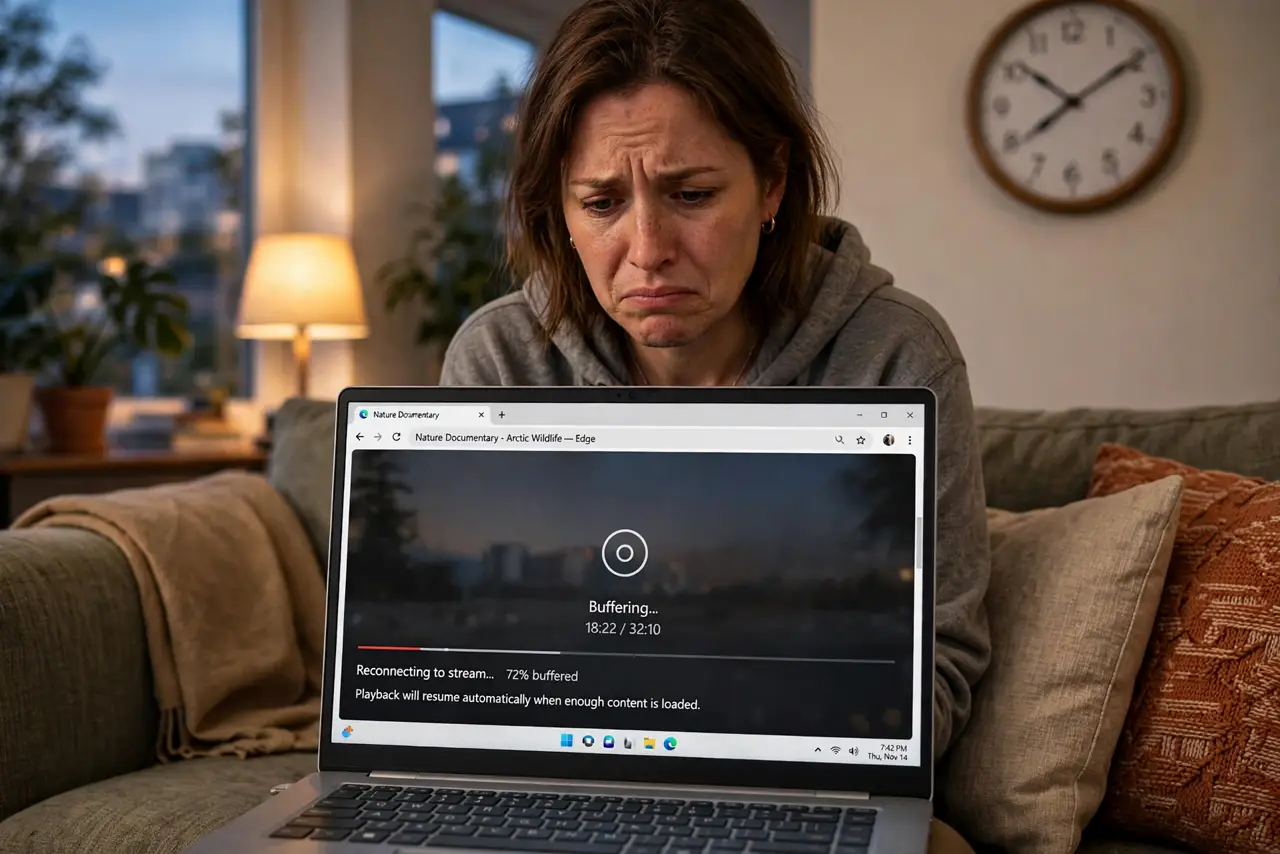
Every evening at eight, your Wi-Fi turns to molasses — video buffers, calls stutter, pages crawl. By midnight it is fine again. This is the prime-time pattern: your neighbors all stream at once, and the shared airwaves (or your ISPs local node) clog. The fix depends on which bottleneck is yours.
TL;DR / Quick Fix
Quick fix: confirm the pattern with speed tests at 8 p.m. versus midnight — big gaps mean congestion, not broken hardware. Switch to clearer channels and prefer 5 GHz evenings. If wired speeds also collapse at prime time, the ISP node is saturated — complain to the provider.
Follow these steps
- Prove the pattern. Run speed tests at 8 p.m. and at midnight for three days. Evening-only collapse is congestion — all-day slowness is something else. Data first, purchases never.
- Change channels for the evening crowd. Prime time is when every neighbor streams. The apartment congestion tactics — least-crowded channel, 5 GHz preference — help most exactly at 8 p.m.
- Test wired at prime time. Plug in with ethernet during the slowdown. If wired is fast, your Wi-Fi is the bottleneck; if wired crawls too, the ISP slowdown pattern points upstream — different fight.
- Stagger the heavy streams. Two 4K streams plus a video call is a lot for one connection. Drop a stream to HD in the evening — the visual difference is small, the bandwidth savings are not.
- Schedule big downloads overnight. Game updates, cloud backups, OS downloads — queue them for after midnight. Your evening self will thank your scheduling self.
- Complain with data. If the ISP node is saturated, one complaint is noise; a log of nightly speeds is evidence. Document two weeks, then call — specifics get escalations.

What NOT to do
- Do not buy a new router for a prime-time problem. Evening congestion is shared airwaves or ISP load — hardware cannot fix either.
- Do not run speed tests once and declare victory. Congestion is a pattern; single tests lie.
- Do not blame the streaming service first. When everything slows at 8 p.m., the pipe is the suspect, not the app.
- Do not ignore the wired test. It is the single step that separates your problem from your ISPs problem.
Frequently asked questions
Why is internet slower at night?
Everyone uses it at once — neighbors share your Wi-Fi airwaves, and neighborhoods share ISP capacity. Prime time is rush hour.
Will a faster plan fix evenings?
Only if the bottleneck is your plan speed. If the ISP node or Wi-Fi airwaves are saturated, a faster plan just hits the same wall.
Does a VPN help at prime time?
Sometimes — if the ISP throttles video specifically. Test with and without; the VPN adds overhead but can dodge throttling.