VPN Protocols Compared
Your VPN app offers OpenVPN, WireGuard, and IKEv2, and picking at random feels wrong. Protocols are the engines under the VPN — they decide speed, battery drain, and how well the tunnel survives switching from Wi-Fi to mobile data. The differences are real, and the right choice depends on your device.
TL;DR / Quick Fix
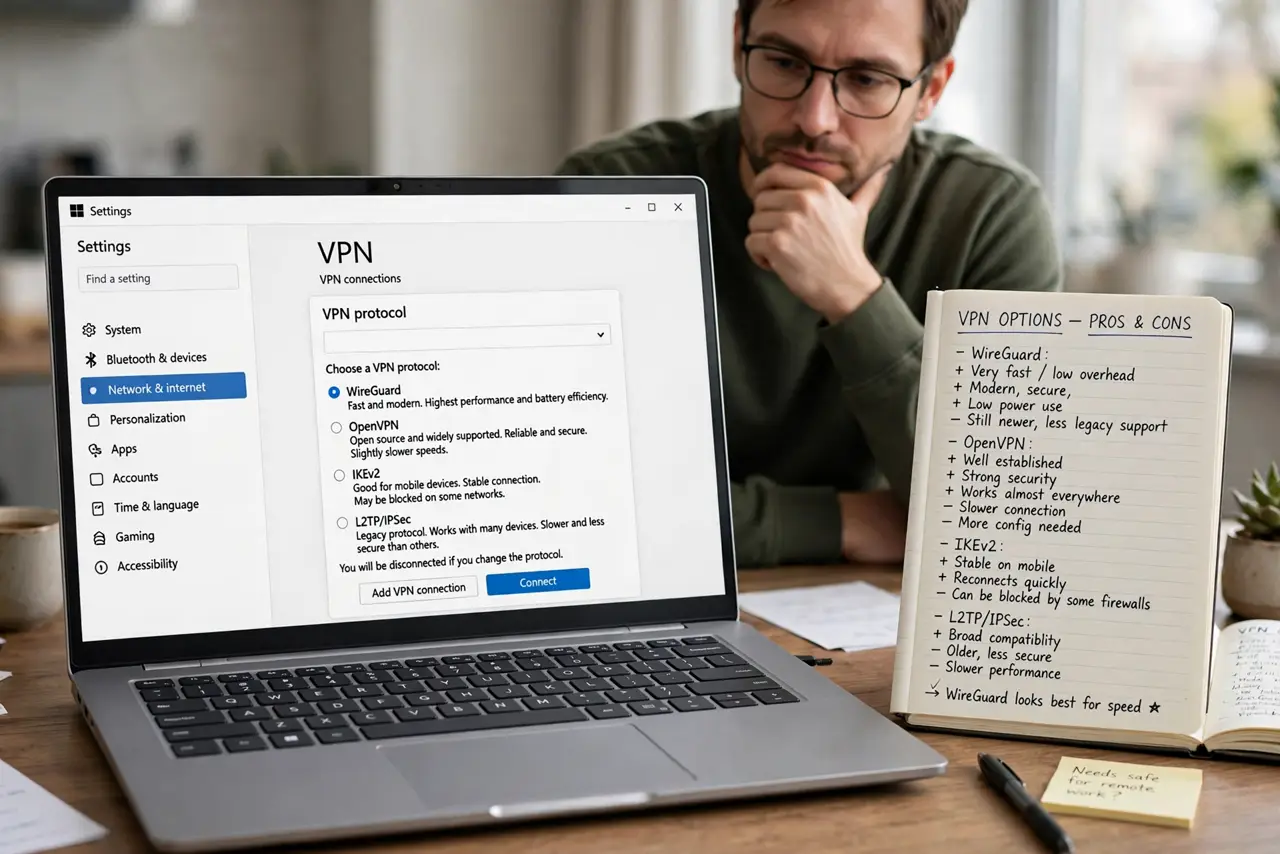
Quick fix: WireGuard is the modern default — fast, light on battery, and quick to reconnect when networks change. OpenVPN is the battle-tested veteran, slower but reliable everywhere, including restrictive networks. IKEv2 suits phones that hop between Wi-Fi and mobile data. Avoid outdated PPTP entirely; it is broken and unsafe.
Follow these steps
- Learn what a protocol actually does. The protocol is the language your device and the VPN server speak to build the encrypted tunnel. It affects speed and reliability, not the strength of the encryption itself.
- Choose WireGuard for modern devices. WireGuard's tiny codebase means fast connections, low battery use, and instant reconnects. Most current apps offer it — if yours does, start here. For a basics refresher, start with the overview first.
- Fall back to OpenVPN on stubborn networks. OpenVPN is slower but slips through restrictive firewalls and odd networks that block WireGuard. When WireGuard will not connect, OpenVPN usually will.
- Use IKEv2 for phones that roam. IKEv2 handles Wi-Fi to mobile-data handoffs gracefully. If your phone's VPN drops every time you leave the house, this protocol often fixes it.
- Avoid PPTP and L2TP. PPTP is cryptographically broken and L2TP is showing its age. No modern app should offer them as the default — if yours does, switch providers.
- Match the protocol to your router too. Router VPNs often support fewer protocols than apps. Check the router's list before committing — the router VPN guide explains the setup end to end.

What NOT to do
- Do not chase the fastest protocol on a slow network. Your ISP speed caps everything — protocol choice cannot beat physics.
- Do not assume a fancy protocol fixes DNS leaks. Leaks are a separate setting; test for them regardless of protocol.
- Do not use PPTP because it is fast. Its speed comes from weak security — that is not a tradeoff worth making.
- Do not switch protocols mid-troubleshoot randomly. Change one thing, test, then change another — otherwise you never learn what worked.
Frequently asked questions
Which protocol is fastest?
Usually WireGuard, by a clear margin on modern hardware. But a slow connection is more often the server or your ISP than the protocol.
Is WireGuard safe if it is newer?
Yes — it has been audited repeatedly and its small codebase is a security feature, not a risk. Newer here means simpler, not experimental.
Why does my VPN offer so many protocols?
Legacy support and edge cases. Most users need exactly one: WireGuard, with OpenVPN as the backup.